


What Is Entity SEO? How Brands Build Authority for Google and AI Search
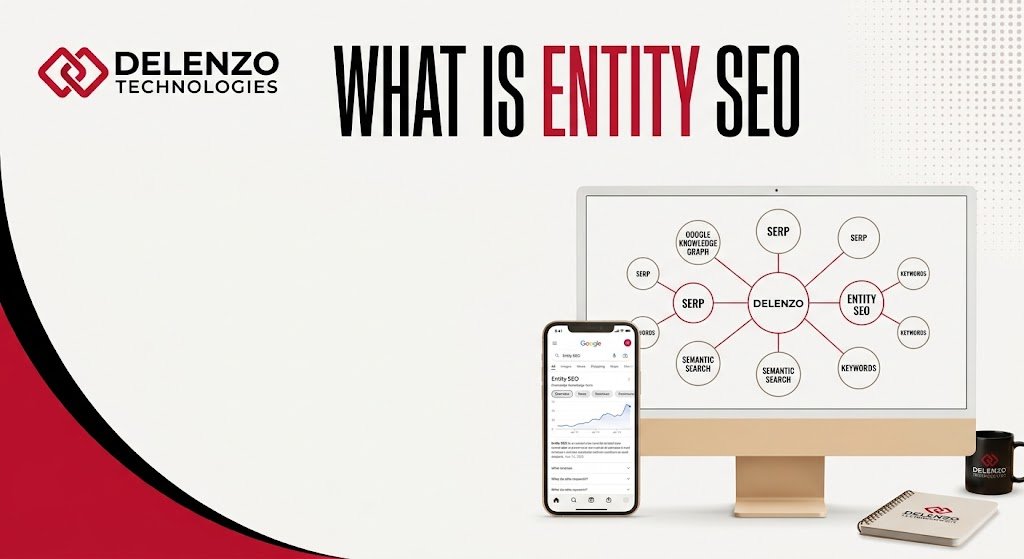
Type a well-known brand name into Google and you'll notice something most business owners never stop to think about. A knowledge panel appears on the right side of the results, pulling together facts about that company from across the web without a single click. That's not luck, and it's not paid placement. It's the visible result of entity SEO working correctly.
Most SEO conversations still center on keywords and backlinks, and those still matter. But the search engines and AI systems shaping visibility in 2026 increasingly think in terms of entities: distinct, well-defined things, whether that's a brand, a person, a product, or a concept, connected to other entities through a web of verified relationships. This article breaks down what entity SEO actually means, why it's become more important as AI search grows, and the specific steps that help a brand build the kind of recognized authority that both Google and AI systems trust.
What an Entity Actually Is in the Context of SEO
An entity is any distinct, identifiable thing that a search engine can recognize and understand independently of the exact words used to describe it. A business is an entity. So is its founder, its physical location, its product line, and even the industry category it operates in. What makes something an entity, rather than just a keyword, is that it has a clear, consistent identity search engines can connect across many different sources.
This matters because keywords are just strings of text, while entities carry meaning. Google's systems, and increasingly the large language models behind AI search tools, don't just match words anymore. They try to understand what a page is actually about, who or what it refers to, and how that thing relates to everything else they already know.
Google has been building this understanding for years through its Knowledge Graph, a massive database connecting entities and the verified facts and relationships between them. When a brand becomes a recognized entity in that graph, with consistent information appearing across trusted sources, Google gains confidence in treating that brand as a legitimate authority rather than just a website with matching keywords.
Why Entity SEO Matters More in the Age of AI Search
Traditional keyword-based SEO still works, but it's no longer the whole picture, especially as AI Overviews, chatbots, and AI-powered search assistants become a bigger part of how people find information. These systems don't crawl a page and match keywords the way older search engines did. They synthesize information across many sources and generate an answer, often citing or referencing specific entities they trust as reliable.
This is where a lot of businesses get caught off guard. A page can rank well in traditional keyword search while being completely absent from AI-generated answers, simply because the underlying brand or topic isn't well-established as a recognized entity across the web. Being mentioned once on a company's own website isn't enough anymore; the same facts need to show up consistently across other credible sources too.
For small and mid-sized businesses, this shift actually creates opportunity. A well-documented, consistently described local business or niche ecommerce brand can build entity recognition faster than a much larger competitor with scattered, inconsistent information across the web.
How Search Engines Build an Understanding of Your Brand as an Entity
Entity recognition doesn't happen from a single source. It builds gradually from a combination of signals scattered across a business's own website, third-party mentions, structured data, and consistent factual information repeated in enough trustworthy places that search engines start treating it as verified.
Structured Data and Schema Markup
Schema markup is one of the clearest, most direct ways to tell search engines exactly what an entity is and how it relates to other entities. Organization schema, for example, explicitly defines a business's name, logo, social profiles, and key facts in a format machines can read without ambiguity, rather than leaving that inference up to a crawler guessing at page content.
This matters more than most businesses realize, because ambiguous or inconsistent naming makes it much harder for search engines to confidently connect all the mentions of a brand into one unified entity. A business appearing as "Delenzo Technologies," "Delenzo Tech," and "Delenzo Marketing Agency" across different sources creates unnecessary friction that clean, consistent schema markup helps resolve.
Consistent NAP and Brand Information Across the Web
NAP consistency, meaning a business's Name, Address, and Phone number appearing identically across directories, review sites, and mentions, has long mattered for local SEO. It matters just as much for entity SEO broadly, because inconsistency signals uncertainty to systems trying to confirm a single, unified identity.
The same principle extends beyond NAP data to broader factual consistency: the same founding year, the same service descriptions, the same leadership names, repeated accurately across a company's website, press mentions, industry directories, and social profiles.
Common Mistakes That Weaken Entity Recognition
Most businesses aren't failing at entity SEO because they're ignoring it entirely. They're failing because a handful of small, fixable inconsistencies are quietly undermining the authority they've otherwise earned.
|
Common Mistake |
Why It Weakens Entity Signals |
What to Do Instead |
|
Inconsistent business name across platforms |
Confuses search engines trying to unify mentions |
Standardize the exact name everywhere it appears |
|
No schema markup on the website |
Forces search engines to infer instead of confirm |
Implement Organization and relevant schema types |
|
Thin or generic "About" page content |
Fails to establish clear expertise or identity |
Write a specific, detailed About page with real credentials |
|
No presence on relevant third-party sources |
Limits external validation of the brand's existence |
Pursue credible mentions, directories, and citations |
|
Treating entity building as a one-time task |
Entity signals decay without ongoing reinforcement |
Maintain and update information consistently over time |
Building Topical Authority Around Your Core Entity
Being recognized as an entity is only part of the equation. Search engines and AI systems also evaluate how much depth and authority a brand demonstrates around the topics connected to that entity, which is where content strategy and entity SEO overlap directly.
A business that only ever publishes shallow, surface-level content about its industry struggles to build the kind of topical authority that strengthens entity trust. A business that consistently publishes genuinely useful, specific content across the range of topics connected to what it does builds a much stronger case that it's a credible source worth citing, whether the citation comes from a traditional search result or an AI-generated answer.
This is also where internal linking plays a bigger role than most businesses give it credit for. Connecting related content together, using clear, descriptive anchor text, helps search engines understand how topics relate to each other within a brand's site, reinforcing the entity relationships being built externally.
From Keyword SEO to Entity SEO: What Actually Changes
It helps to see the shift side by side rather than treat it as an abstract concept.
|
Element |
Traditional Keyword SEO |
Entity SEO |
|
Core focus |
Matching specific search phrases |
Building a recognized, connected identity |
|
Primary signal |
Keyword usage and backlinks |
Consistency, structured data, verified mentions |
|
Content goal |
Rank for individual queries |
Establish topical depth and authority |
|
Visibility outcome |
Search engine results page rankings |
Knowledge panels, AI citations, broader recognition |
|
Long-term durability |
Vulnerable to algorithm and keyword shifts |
More resilient, built on verified relationships |
What This Means for AI-Powered Search and GEO
Generative Engine Optimization, often shortened to GEO, has emerged as a natural extension of entity SEO, focused specifically on how a brand gets referenced, cited, or recommended by AI-powered search tools and chatbots. The overlap is significant, because the same consistency and authority signals that help traditional search engines recognize an entity also help AI systems trust a brand enough to reference it in a generated answer.
The businesses positioning themselves well for this shift aren't treating entity SEO and traditional content strategy as separate efforts. They're building one coordinated approach: structured data that clearly defines who they are, content that demonstrates real expertise across their core topics, and consistent factual information reinforced across the web, all working together to build the kind of authority that holds up whether a customer finds them through a Google search, an AI Overview, or a direct chatbot recommendation.
Getting Started With Entity SEO for Your Brand
Entity SEO isn't a one-time technical fix, and it isn't something that produces overnight results the way a paid ad campaign might. It's a long-term investment in becoming a clearly defined, consistently described, genuinely authoritative source within your specific industry, built through structured data, consistent information, and content that actually demonstrates expertise rather than just mentioning keywords.
Delenzo Technologies works with businesses to build exactly this kind of foundation, connecting SEO, content strategy, and technical implementation into a single approach designed for how both Google and AI search actually work in 2026. If your brand's information is scattered, inconsistent, or thin across the web, that's the starting point worth addressing before chasing any new keyword strategy.
Frequently Asked Questions
Is entity SEO the same thing as traditional SEO? No, entity SEO builds on traditional SEO rather than replacing it, focusing specifically on how search engines recognize and connect a brand's identity across the web. Keyword optimization still matters, but entity SEO adds the layer of consistency and structured data that helps establish real authority.
How long does it take to build entity recognition for a brand? There's no fixed timeline, since it depends on how much existing scattered or inconsistent information needs to be cleaned up first. Businesses that commit to consistent naming, schema markup, and credible mentions typically see stronger recognition building over several months rather than weeks.
Does a small business need entity SEO, or is it only relevant for large brands? Small businesses benefit significantly, particularly because scattered, inconsistent information is often easier to fix for a smaller brand than a large one with years of inconsistent mentions across the web. Entity SEO can actually be a faster path to authority for a smaller, well-documented business in a specific niche.
What's the difference between entity SEO and GEO? GEO, or generative engine optimization, focuses specifically on how a brand gets cited or recommended by AI-powered search tools, while entity SEO is the broader foundation of building a recognized, consistent identity across the web. Strong entity SEO tends to support and strengthen GEO efforts rather than existing as a separate strategy.
Does schema markup alone build entity authority? No, schema markup helps search engines confirm facts about an entity, but it doesn't create authority on its own. It needs to be paired with consistent information across other credible sources and genuinely useful content that demonstrates real expertise.
How does entity SEO affect a brand's chances of appearing in AI Overviews or chatbot answers? Brands with consistent, well-documented information and clear topical authority are more likely to be recognized as trustworthy sources that AI systems reference when generating answers. There's no guaranteed way to force inclusion, but strengthening entity signals meaningfully improves the odds over time.
