


Why Healthcare Organizations Need Vulnerability Assessment and Penetration Testing
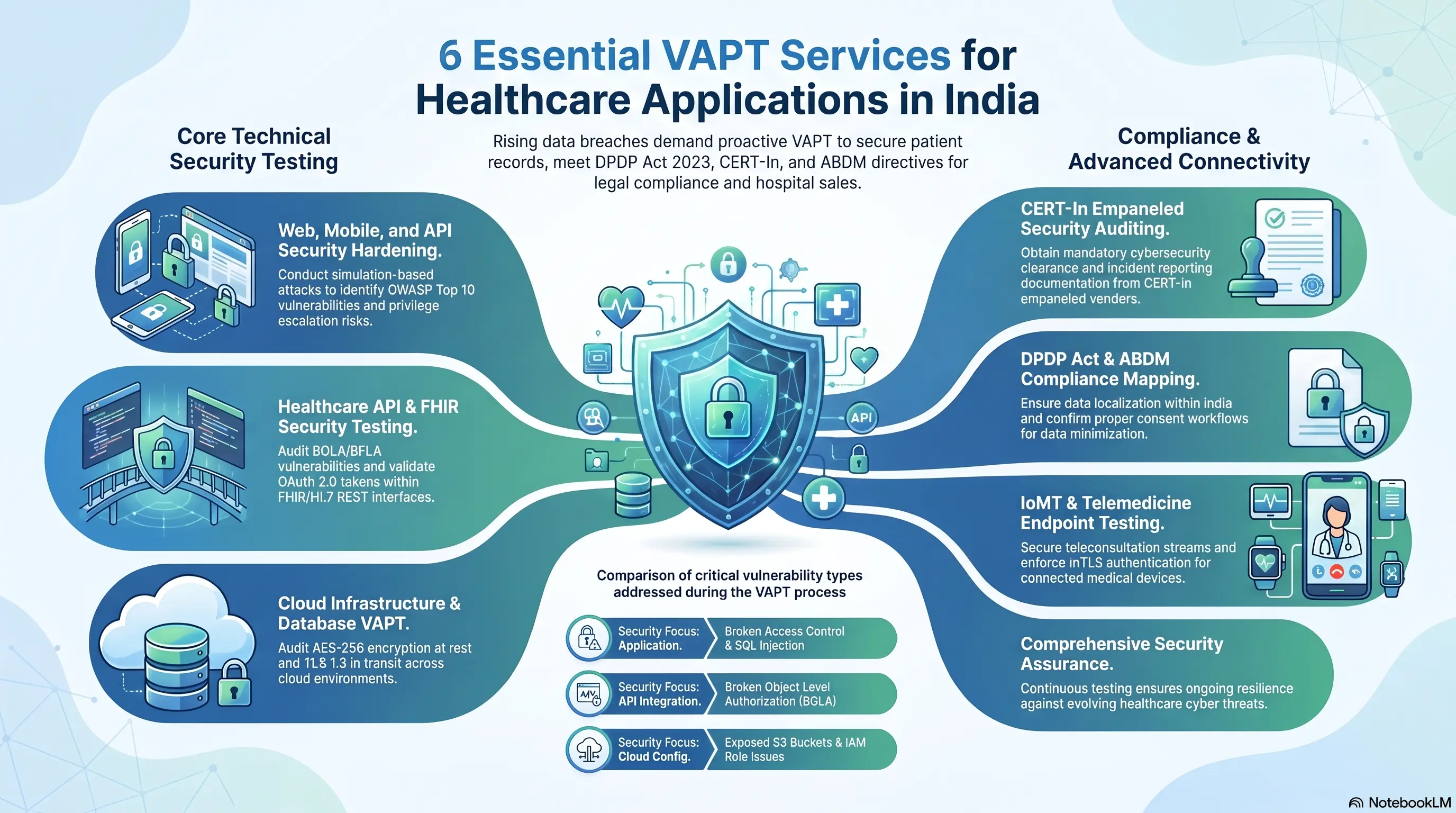
Healthcare organizations increasingly depend on digital systems for patient management, appointments, diagnostics, communication, billing, telemedicine, and clinical operations.
This digital expansion creates a broad technology environment that may include web applications, mobile applications, APIs, connected devices, cloud platforms, and internal infrastructure.
Vulnerability assessment and penetration testing can help healthcare organizations identify security weaknesses across these systems and determine which vulnerabilities represent meaningful risk.
Vulnerability Assessment and Penetration Testing for Healthcare Systems
Healthcare applications often process sensitive information and support operationally important workflows.
Testing can assess areas including:
- Authentication
- Authorization
- Session management
- Input validation
- API security
- Data exposure
- Access controls
- Application configurations
- Administrative interfaces
The testing methodology should account for the specific purpose of the system and the sensitivity of the information it handles.
Vulnerability Assessment Services for Healthcare Infrastructure
Healthcare organizations may operate numerous servers, endpoints, network devices, applications, and cloud workloads.
Vulnerability assessment services can help identify weaknesses across these technology assets.
Common areas of evaluation include:
- Outdated software
- Misconfigured systems
- Exposed services
- Weak authentication
- Insecure configurations
- Unnecessary network exposure
However, discovery is only the first step. Security teams need sufficient context to determine whether a finding is exploitable and how it should be prioritized.
Securing Healthcare Mobile Applications
Mobile applications are increasingly used for patient engagement, appointments, communication, and healthcare-related services.
A mobile application penetration testing service can evaluate the security of the application and its interaction with backend systems.
Testing may examine:
- Authentication mechanisms
- Session handling
- Local data storage
- API communication
- Authorization
- Sensitive information exposure
- Application configuration
- Backend access controls
Mobile security should not be evaluated independently from API security because many mobile applications rely heavily on backend services.
Why Healthcare APIs Matter
APIs often connect healthcare applications with databases, administrative systems, mobile applications, and other platforms.
A security weakness in an API can potentially expose functionality or information beyond what an authorized user should access.
Testing can focus on:
- Authentication
- Authorization
- Object-level access
- Input validation
- Error handling
- Rate controls
- Data exposure
The exact scope should depend on the architecture and intended API functionality.
Penetration Testing vs Vulnerability Assessment in Healthcare
These activities complement each other but serve different purposes.
A vulnerability assessment focuses on identifying and evaluating weaknesses across defined assets.
Penetration testing takes a more adversarial approach by attempting controlled exploitation of selected weaknesses.
Healthcare organizations benefit from both because a vulnerability's presence does not necessarily indicate that an attacker can successfully exploit it. Validation helps establish realistic exposure.
Prioritizing Healthcare Security Findings
Healthcare teams often operate under resource and operational constraints. A large vulnerability report can therefore become difficult to manage without appropriate prioritization.
Findings can be assessed using:
- Technical severity
- Exploitability
- Asset exposure
- Information sensitivity
- User privileges
- Operational importance
- Existing security controls
This provides a more practical basis for remediation decisions.
When Should Healthcare Businesses Test Their Systems?
Security testing can be valuable:
- Before major application launches
- Following significant software changes
- During infrastructure migrations
- After major architecture changes
- During periodic security reviews
- Following significant remediation
- Before introducing new externally accessible services
Testing should always be planned to avoid unnecessary disruption to critical healthcare operations.
Creating a Sustainable Healthcare Security Program
A strong healthcare security strategy does not end when a penetration testing report is delivered.
Organizations should establish a repeatable process for:
Discover → Validate → Prioritize → Remediate → Retest
This lifecycle helps security and technology teams turn testing findings into measurable improvements.
For Indian healthcare organizations, vulnerability assessment and penetration testing can provide valuable visibility into the security of digital healthcare environments while helping teams identify and address weaknesses before they become serious incidents.
