


VAPT Report: What a Good Security Assessment Report Should Tell Your Business
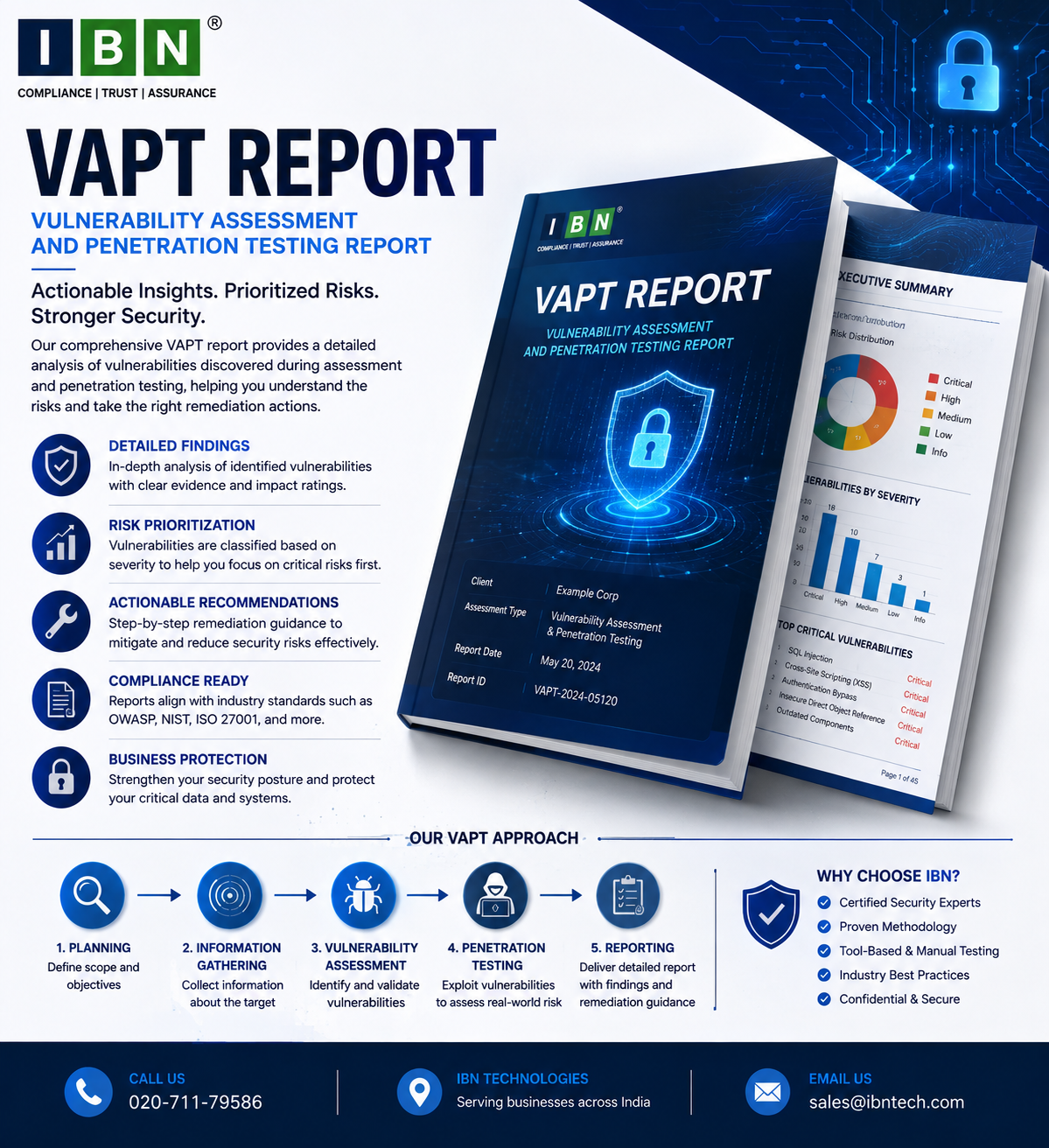
A security assessment does not end when testing activities are completed.
The results need to be documented in a way that helps technical teams understand vulnerabilities and helps business stakeholders understand the risks those vulnerabilities may create.
This is the purpose of a vapt report.
A useful report should do more than list vulnerabilities.
It should explain what was assessed, how the assessment was conducted, what was discovered, which findings matter most, what their potential impact could be, and what actions should be taken.
When structured properly, the report becomes a practical security-management document rather than simply a record of testing activity.
What Is a VAPT Report?
A VAPT report is the documented outcome of a Vulnerability Assessment and Penetration Testing engagement.
It generally records:
- Assessment scope
- Testing methodology
- Assets assessed
- Security findings
- Severity
- Technical evidence
- Business impact
- Remediation recommendations
- Retesting information
The exact format can differ between providers and organizations.
However, the report should always reflect the agreed assessment scope and the actual work performed.
Why the VAPT Report Matters
Security testing generates technical information.
Businesses need to turn that information into decisions.
A good report helps answer questions such as:
What was tested?
What vulnerabilities were found?
Which vulnerabilities are most important?
What could happen if they are exploited?
What should be fixed first?
How should the issue be remediated?
Has remediation been verified?
Without this context, a long list of technical findings may be difficult for an organization to act upon.
What Should Be Included in a VAPT Report?
A comprehensive report can contain several major sections.
Executive Summary
The executive summary provides a high-level view of the assessment.
It can describe:
- Overall security observations
- Major findings
- Critical risks
- General security posture
- Recommended priorities
This section should be understandable to business leaders who may not need detailed technical information.
Assessment Scope
The report should clearly identify what was tested.
Scope information can include:
- Applications
- IP addresses
- Domains
- APIs
- Network ranges
- Cloud resources
- Mobile applications
- Specific environments
Clearly documenting scope prevents confusion about what was and was not assessed.
Testing Methodology
The report should explain how the assessment was conducted.
Depending on the engagement, methodology may include:
- Asset discovery
- Enumeration
- Vulnerability assessment
- Manual testing
- Authentication testing
- Authorization testing
- Business-logic testing
- Configuration assessment
- Controlled validation
- Retesting
The methodology should correspond to the actual engagement rather than presenting a generic checklist.
Rules of Engagement
The report can also document important testing boundaries.
These may include:
- Authorized targets
- Testing dates
- Testing windows
- Restrictions
- Excluded systems
- Production limitations
- Testing conditions
This provides useful context when reviewing the findings.
Finding Classification
A report generally categorizes vulnerabilities according to severity.
Common categories include:
- Critical
- High
- Medium
- Low
- Informational
Severity helps organizations understand technical significance.
However, severity should not be the only factor used for remediation decisions.
Understanding Business Risk
Technical severity does not always equal business priority.
A vulnerability affecting a highly critical public-facing system may deserve immediate attention even if its technical rating is not the highest.
Risk can depend on:
- Internet exposure
- Business criticality
- Data sensitivity
- Exploitability
- Required privileges
- Number of affected users
- Existing controls
- Attack-path potential
A strong report provides enough context for organizations to make informed decisions.
Technical Description of a Finding
Each significant vulnerability should have a clear explanation.
A finding can describe:
- What the vulnerability is
- Where it occurs
- How it was identified
- What conditions are required
- Why the issue matters
The description should be specific enough for technical teams to understand the problem.
Evidence
Technical evidence helps support the finding.
Depending on the assessment, evidence can include:
- Request and response information
- Configuration details
- Affected asset information
- Screenshots
- Relevant application behavior
- Security-tool output
- Controlled validation results
Evidence should be sufficient to demonstrate the finding without unnecessarily exposing sensitive information.
Business Impact
Technical descriptions alone may not explain why a vulnerability matters.
The report should translate important findings into potential business consequences.
For example, a security weakness may potentially lead to:
- Unauthorized data access
- Account compromise
- Privilege escalation
- Service disruption
- Exposure of confidential information
- Unauthorized transactions
The actual impact depends on the affected system and the conditions required for exploitation.
Remediation Recommendations
A finding becomes more useful when the organization understands how to address it.
Recommendations can include:
- Applying security updates
- Correcting access controls
- Restricting network exposure
- Improving authentication
- Changing configuration
- Updating dependencies
- Removing unnecessary services
- Improving application logic
Recommendations should address the underlying issue where possible.
Root Cause Analysis
Some vulnerabilities are symptoms of a broader problem.
For example, multiple applications may have similar authorization weaknesses.
Instead of fixing each endpoint independently, the organization may need to review its authorization framework.
Root-cause analysis can help identify:
- Development-process problems
- Configuration-management issues
- Architectural weaknesses
- Access-control design problems
- Patch-management gaps
This can prevent similar vulnerabilities from appearing repeatedly.
Attack Paths and Vulnerability Chaining
Individual findings should not always be considered independently.
A VAPT assessment may reveal a sequence such as:
Initial weakness
↓
Account access
↓
Privilege escalation
↓
Internal access
↓
Sensitive resource
Several individual findings may combine into a more serious attack path.
A report should highlight important relationships between vulnerabilities when they have been validated.
This can significantly improve remediation prioritization.
Web Application Findings
Web application assessments can identify issues involving:
- Authentication
- Authorization
- Session management
- Input validation
- Access controls
- File handling
- Business logic
- APIs
If an organization has a mobile application connected to backend services, mobile application penetration testing findings may also need to consider the relationship between the mobile client and its APIs.
Network Findings
Network assessments can produce findings involving:
- Exposed services
- Outdated software
- Weak authentication
- Network segmentation
- Remote access
- Insecure protocols
- Configuration weaknesses
The report should identify affected systems and explain why the exposure matters.
Cloud Findings
Cloud assessments may identify:
- Publicly accessible resources
- Excessive permissions
- Weak identity controls
- Network configuration issues
- Storage exposure
- Security-policy weaknesses
Cloud findings should be explained within the context of the organization's architecture.
A publicly accessible resource, for example, may have very different risk depending on what information or functionality it exposes.
Vulnerability Assessment Findings vs Penetration Testing Findings
A VAPT engagement may contain findings discovered through automated vulnerability assessment and findings identified through deeper manual testing.
These should be interpreted appropriately.
Automated assessment may identify:
Potential vulnerable software
Manual testing may identify:
An exploitable authorization weakness
Both findings can be important, but they provide different types of information.
False Positives in the Report
Not every automated finding should necessarily appear as a confirmed vulnerability.
A potential issue may be invalidated after manual investigation.
For example:
- A vulnerable feature may be disabled.
- Access may be restricted.
- A compensating control may prevent exploitation.
- A vendor-specific fix may already be present.
Good reporting distinguishes validated findings from unconfirmed scanner output.
False Negatives and Report Limitations
A VAPT report should also be understood within its limitations.
An assessment cannot guarantee that every vulnerability has been identified.
The result depends on:
- Scope
- Testing duration
- Available credentials
- Application functionality
- Environmental changes
- Testing methodology
The report should therefore avoid presenting the assessment as proof that the environment is completely secure.
Severity and Risk Rating
A useful report can provide both technical severity and business context.
For example:
|
Factor |
Consideration |
|
Severity |
How technically serious is the issue? |
|
Exploitability |
How realistic is exploitation? |
|
Exposure |
Is the asset publicly accessible? |
|
Business impact |
What operations could be affected? |
|
Data |
What information could be exposed? |
|
Privileges |
What access is required? |
|
Attack path |
Can it combine with other findings? |
This provides a stronger foundation for remediation decisions.
Prioritizing Remediation
Organizations may receive dozens or hundreds of findings.
Trying to fix everything simultaneously may not be practical.
A useful approach is to prioritize findings based on:
Critical Business Systems
Issues affecting important systems should receive appropriate attention.
Internet Exposure
Publicly accessible assets can require faster remediation.
Sensitive Data
Systems processing confidential or regulated information may require greater priority.
Exploitability
Issues that can realistically be exploited may require urgent action.
Attack Paths
Findings that enable additional compromise can have greater significance.
What Makes a VAPT Report Useful to Developers?
Developers need actionable technical information.
A useful finding should provide enough information to understand:
- The affected component
- The vulnerable behavior
- The conditions required
- The potential impact
- The recommended correction
For application vulnerabilities, examples or relevant evidence can help developers reproduce and understand the problem.
What Makes a VAPT Report Useful to Management?
Management usually needs a different level of detail.
They may want to understand:
- Overall risk
- Major findings
- Business impact
- Priority areas
- Remediation status
- Remaining exposure
The executive summary should therefore translate technical results into business language.
Remediation Tracking
The report can become more useful when findings are tracked after the assessment.
A remediation tracker can contain:
|
Finding |
Severity |
Owner |
Status |
Target Date |
Retest |
|
Finding A |
High |
Security Team |
Open |
Defined internally |
Pending |
|
Finding B |
Medium |
Development |
In Progress |
Defined internally |
Pending |
|
Finding C |
Low |
Infrastructure |
Resolved |
Completed |
Required |
This creates accountability and makes it easier to monitor progress.
Retesting
Retesting determines whether reported vulnerabilities have been addressed.
A typical process is:
Finding identified
↓
Remediation implemented
↓
Retest performed
↓
Fix verified
↓
Finding closed
Retesting is particularly valuable for significant vulnerabilities.
A reported fix should not automatically be considered complete without appropriate verification.
What a Retest Report Should Show
A retest can document:
- Original finding
- Remediation status
- Testing performed
- Current result
- Remaining exposure
- Closure status
If the vulnerability remains partially unresolved, the report should explain what remains.
VAPT Reports and Compliance
Some organizations conduct security assessments because of contractual, regulatory, or industry requirements.
In such cases, the report may need to demonstrate:
- Defined scope
- Testing methodology
- Assessment date
- Findings
- Remediation
- Retesting
However, compliance requirements can differ significantly.
Organizations should determine the exact documentation requirements applicable to their situation rather than assuming every VAPT report satisfies every requirement.
How Long Should a VAPT Report Be?
There is no ideal page count.
A report should be detailed enough to communicate the findings and evidence clearly.
A longer report is not automatically better.
A useful report prioritizes:
- Accuracy
- Clarity
- Relevant evidence
- Actionable remediation
- Risk context
The objective is usefulness, not volume.
Common Problems With Poor VAPT Reports
Too Much Technical Jargon
Business stakeholders may struggle to understand the findings.
No Business Impact
Technical findings may not explain why they matter.
Generic Recommendations
Advice such as “fix the vulnerability” is not particularly useful.
Unclear Scope
Readers may not know what was actually tested.
No Evidence
Technical teams may struggle to reproduce findings.
No Prioritization
A large list without priorities can slow remediation.
Scanner Output Presented as Confirmed Findings
Automated results should be validated where appropriate.
No Retesting Information
Organizations may not know whether fixes were verified.
How to Evaluate a VAPT Report From a Security Provider
Businesses reviewing reports from vulnerability assessment services should look for evidence that the provider performed meaningful analysis.
Questions to consider include:
- Is the scope clearly documented?
- Are findings technically specific?
- Is evidence included?
- Are false positives addressed?
- Is business impact explained?
- Are remediation recommendations practical?
- Are findings prioritized?
- Are attack paths discussed where relevant?
- Is retesting available?
- Is the report understandable to both technical and management teams?
A report should demonstrate the quality of the assessment rather than simply contain a large number of findings.
VAPT Reporting for Indian Businesses
Organizations in India operate across a broad range of industries and technology environments.
Their VAPT reporting requirements can vary depending on:
- Business sector
- Technology environment
- Customer requirements
- Contractual obligations
- Internal security policies
- Applicable regulations
A report should therefore be tailored to the organization's actual requirements.
Generic reporting may provide less value than documentation designed around the assessed environment.
Turning the Report Into a Security Improvement Plan
The report should lead to action.
A practical process is:
Review findings
↓
Validate priorities
↓
Assign owners
↓
Set remediation targets
↓
Implement fixes
↓
Retest
↓
Track remaining risks
↓
Reassess when appropriate
This transforms the report from a static document into part of the organization's security-management process.
Final Thoughts
A VAPT report is more than a collection of vulnerabilities.
It is the bridge between technical security testing and business decision-making.
A strong report explains:
- What was tested
- How it was tested
- What was discovered
- Why the findings matter
- Which risks deserve attention
- How they can be remediated
- Whether important fixes were verified
The best report is not necessarily the longest one.
It is the one that gives security teams enough technical detail to act and gives decision-makers enough context to understand the risks.
Ultimately, the value of a VAPT engagement should be measured by what happens after the report is delivered.
Find the weakness.
Understand the risk.
Fix the problem.
Verify the fix.
That is how security assessment results become measurable security improvements.
Frequently Asked Questions About VAPT Reports
What is a VAPT report?
A VAPT report documents the results of a Vulnerability Assessment and Penetration Testing engagement, including scope, methodology, findings, severity, evidence, impact, remediation recommendations, and applicable retesting results.
What should a VAPT report contain?
A comprehensive report can include an executive summary, scope, methodology, detailed findings, technical evidence, business impact, severity, remediation recommendations, and retesting information.
Who should read a VAPT report?
Security teams, developers, infrastructure teams, IT leadership, risk teams, and management may all use the report, although each group may focus on different sections.
Why is the executive summary important?
It translates technical findings into high-level business risks and priorities, allowing management to understand the most important security issues without reviewing every technical detail.
Should every scanner finding be included in a VAPT report?
Not necessarily. Potential findings should be appropriately reviewed and validated. False positives should not be presented as confirmed vulnerabilities.
How are VAPT findings prioritized?
Priority can consider severity, exploitability, exposure, business criticality, data sensitivity, required privileges, existing controls, and potential attack paths.
Why should a VAPT report include remediation recommendations?
Remediation guidance helps technical teams understand what actions can reduce or eliminate the identified security risk.
Is retesting included in every VAPT report?
Not necessarily. Retesting depends on the engagement scope and provider's service. When performed, retesting can verify whether important vulnerabilities have been remediated.
Does a VAPT report guarantee that an organization is secure?
No. A VAPT assessment evaluates a defined scope at a particular point in time. Changes to applications, infrastructure, configurations, and vulnerabilities can introduce new risks.
How long should a VAPT report be?
There is no fixed length. It should contain enough accurate technical information, evidence, context, and remediation guidance to make the findings actionable.
Can a VAPT report support compliance requirements?
It may provide evidence of security testing, but specific documentation requirements vary by industry, contract, regulation, and organization. The applicable requirements should be confirmed separately.
What should businesses do after receiving a VAPT report?
They should review and prioritize findings, assign remediation owners, implement fixes, conduct appropriate retesting, and track unresolved risks until they are addressed or formally accepted.
