


Understanding SOC 1 vs SOC 2 vs SOC 3: Which Report Does Your Business Need?
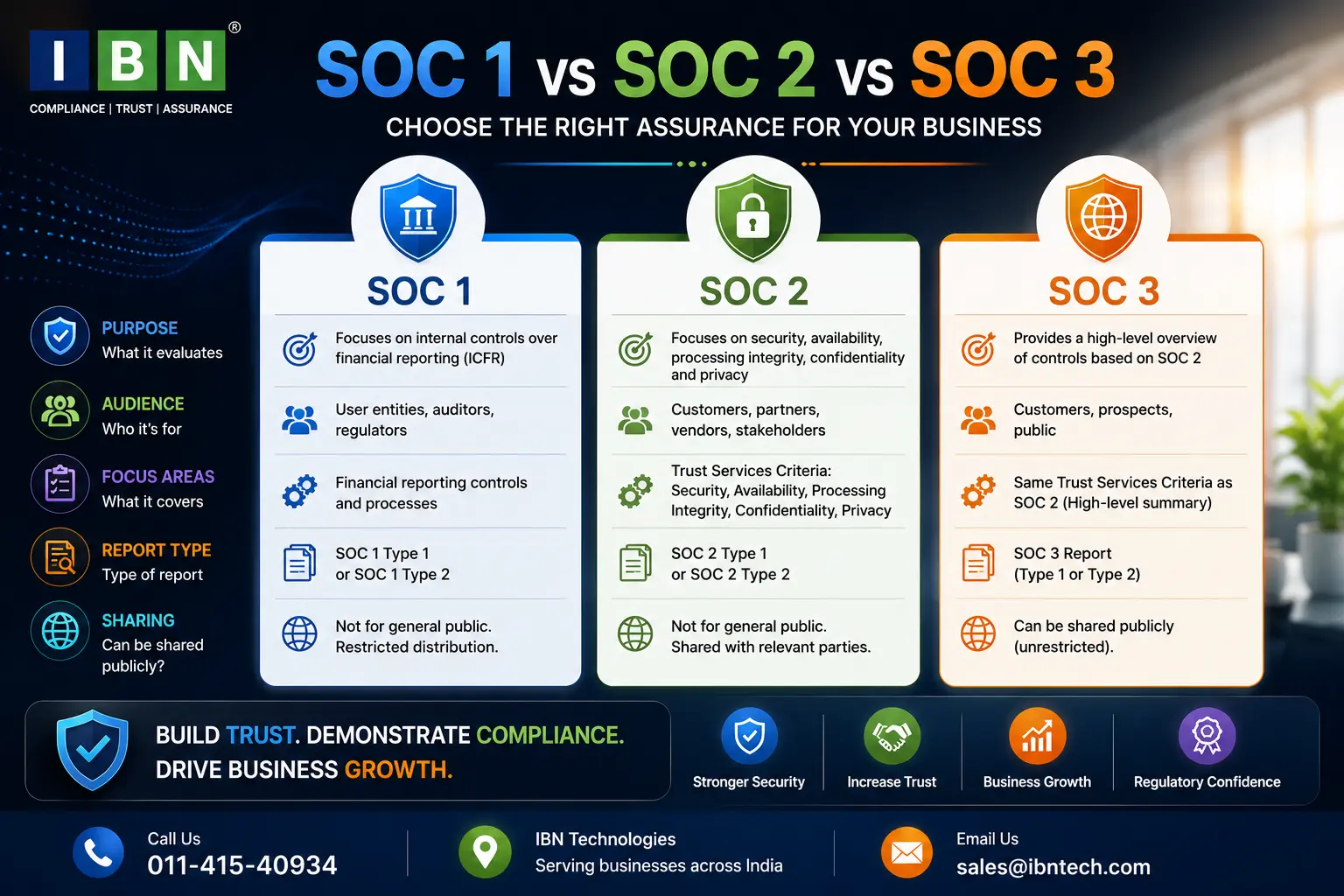
As Indian IT companies, SaaS startups, and B2B service providers expand into global markets, customers increasingly expect independent assurance that their vendors maintain robust security and operational controls. During vendor assessments, organizations often encounter requests for SOC reports, but many struggle to understand the differences between SOC 1 vs SOC 2 vs SOC 3. While all three reports evaluate organizational controls, they serve different purposes and audiences. Selecting the right report helps businesses meet customer expectations, streamline enterprise procurement, and strengthen trust with international clients. With India's Digital Personal Data Protection (DPDP) Act reinforcing the importance of responsible data governance, understanding these reports has become essential for organizations pursuing sustainable global growth.
What Are SOC Reports?
SOC reports are independent assessments that evaluate an organization's internal controls. Each report is designed for a different business purpose, depending on the type of services provided and the information customers need to assess.
For technology companies, cloud providers, managed service providers, fintech firms, and outsourcing organizations, these reports demonstrate operational maturity and strengthen customer confidence during vendor evaluations.
SOC 1 vs SOC 2 vs SOC 3: What Is the Difference?
Although the reports share similar evaluation methodologies, each addresses different business objectives.
|
Report |
Primary Focus |
Typical Audience |
Best For |
|
SOC 1 |
Controls affecting financial reporting |
Customers, auditors, finance teams |
Payroll providers, financial service organizations |
|
SOC 2 |
Security, availability, confidentiality, processing integrity, and privacy controls |
Enterprise customers, partners, procurement teams |
SaaS companies, IT service providers, cloud businesses |
|
SOC 3 |
Public summary of security controls |
Prospective customers, website visitors, marketing |
Organizations wanting to publicly demonstrate security commitment |
The biggest distinction is that SOC 2 contains detailed control testing, while SOC 3 presents a simplified version suitable for public distribution.
When Should Your Business Choose SOC 1?
SOC 1 is appropriate when the services you provide directly impact a customer's financial reporting processes.
Examples include:
- Payroll processing companies
- Financial transaction processors
- Accounting service providers
- Financial software vendors
- Organizations managing accounting data
Most technology companies that primarily handle customer data rather than financial reporting generally require SOC 2 instead of SOC 1.
Why Is SOC 2 the Preferred Choice for Indian IT Companies?
For Indian SaaS businesses, cloud providers, managed service providers, BPOs, and technology consulting firms, SOC 2 has become the most requested compliance report by international customers.
A SOC 2 report demonstrates that an organization has implemented effective controls across the five Trust Services Criteria:
Security
Protects systems against unauthorized access, cyber threats, and operational risks through administrative and technical safeguards.
Availability
Ensures services remain reliable through resilient infrastructure, disaster recovery planning, monitoring, and backup management.
Processing Integrity
Confirms that systems process information accurately, consistently, and according to business commitments.
Confidentiality
Protects sensitive business information through encryption, access controls, secure storage, and controlled information sharing.
Privacy
Demonstrates responsible handling of personal information throughout its lifecycle while supporting governance practices aligned with the DPDP Act.
What Is SOC 3 and When Should You Use It?
SOC 3 is designed for organizations that want to publicly demonstrate their commitment to security without sharing detailed audit findings.
Unlike SOC 2, which contains confidential testing results intended for customers under controlled distribution, SOC 3 provides a high-level overview suitable for marketing materials, websites, investor communications, and public trust-building initiatives.
Many organizations that complete SOC 2 also publish a SOC 3 report to showcase their security maturity to prospective customers.
Which SOC Report Is Best for Your Organization?
Selecting the right report depends on your services and customer expectations.
- Choose SOC 1 if your services affect customer financial reporting.
- Choose SOC 2 if you manage customer information, cloud infrastructure, or technology services.
- Choose SOC 3 if you want to publicly communicate your commitment to security after completing the detailed assessment.
For most Indian technology companies targeting enterprise clients in the US and other global markets, SOC 2 provides the strongest competitive advantage.
How Does SOC 2 Support DPDP Readiness?
Although SOC reports and the DPDP Act have different objectives, SOC 2 encourages governance practices that complement India's evolving privacy framework.
Organizations implementing structured access controls, incident response planning, vendor management, employee awareness programs, and secure data handling procedures strengthen both customer assurance and regulatory preparedness. A unified governance strategy reduces operational risk while improving long-term compliance maturity.
Why Partner with IBN Technologies for SOC 2 Compliance?
Understanding the difference between SOC reports is only the first step. Successfully preparing for SOC 2 requires expertise across cybersecurity, governance, documentation, operational controls, and audit readiness.
IBN Technologies provides comprehensive SOC 2 consulting services, including readiness assessments, gap analysis, policy development, security control implementation, documentation support, audit preparation, and ongoing compliance management. The structured approach helps organizations simplify compliance while reducing project complexity.
Supported by internationally recognized certifications in quality management, IT service management, and information security management, IBN Technologies enables Indian businesses to strengthen cybersecurity, improve governance, and confidently meet international customer expectations.
Frequently Asked Questions
What is the main difference between SOC 1, SOC 2, and SOC 3?
SOC 1 focuses on financial reporting controls, SOC 2 evaluates security and operational controls, and SOC 3 provides a public summary of security assurance.
Which SOC report do SaaS companies usually need?
Most SaaS companies pursue SOC 2 because enterprise customers expect independent assurance regarding information security and data protection.
Can an organization obtain both SOC 2 and SOC 3?
Yes. Many organizations complete a detailed SOC 2 assessment and then publish a SOC 3 report to communicate their security commitment publicly.
How do SOC reports help Indian businesses?
They strengthen customer trust, simplify vendor assessments, support international expansion, improve cybersecurity governance, and complement privacy initiatives under the DPDP Act.
Final Thoughts
Understanding SOC 1 vs SOC 2 vs SOC 3 is essential for Indian businesses serving global customers. While each report has a distinct purpose, SOC 2 remains the most valuable for technology companies seeking enterprise contracts and long-term customer trust. By partnering with IBN Technologies, organizations gain expert support throughout their SOC 2 journey from readiness assessment and control implementation to audit preparation and continuous compliance helping them build a strong security foundation for sustainable international growth.
