


The Eyes of the Machine: How Vehicle Position Sensing Technology Is Enabling Smarter Cars
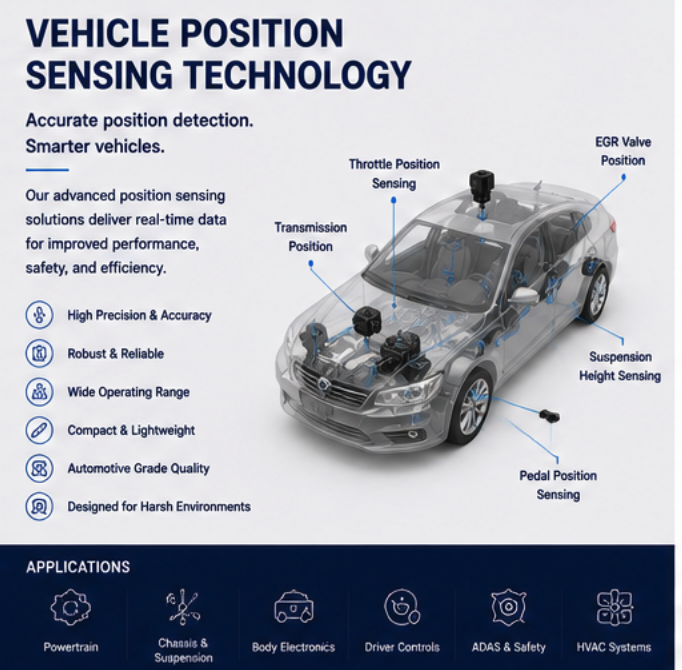
Every time you press the accelerator, a sensor measures exactly how far you have moved the pedal and tells the engine computer. When you turn the steering wheel, sensors track its angle and speed, informing stability control and lane-keeping systems. This invisible network of measurement is Vehicle Position Sensing Technology, the foundation upon which modern automotive electronics are built. Without these precise measurements, electronic fuel injection, anti-lock brakes, adaptive cruise control, and autonomous driving would be impossible. Working alongside Automotive Displacement Sensors, these technologies measure everything from throttle position to suspension height with remarkable accuracy.
What Is Vehicle Position Sensing?
At its core, position sensing is the measurement of an object's location relative to a reference point. In automotive applications, sensors measure:
-
Linear position: How far something has moved along a straight line (e.g., throttle pedal position, brake pedal travel, suspension height).
-
Angular position: How far something has rotated (e.g., steering wheel angle, camshaft position, throttle plate angle).
-
Proximity: Whether an object is near a specific point (e.g., gear selection, door closure).
Vehicle Position Sensing Technology converts mechanical motion into an electrical signal that the vehicle's computers can interpret.
Why Precision Matters
Consider the throttle pedal. A driver presses the pedal, and the engine must respond instantly and predictably. If the sensor is inaccurate or slow, the engine may hesitate or surge. Modern throttle position sensors have resolution of 0.1 degrees or better, updating hundreds of times per second.
Similarly, brake pedal sensors must detect the driver's intent (stopping) before hydraulic pressure builds. Electronic brake boosters use pedal position data to pre-charge the braking system, reducing stopping distance.
Common Position Sensing Technologies
Several distinct technologies are used to measure position, each with trade-offs:
Potentiometer (Contact-Based):
-
How it works: A wiper slides along a resistive strip. Resistance changes with position.
-
Pros: Simple, inexpensive, well-understood.
-
Cons: Wears over time (mechanical contact), susceptible to contamination.
-
Applications: Throttle position (older vehicles), HVAC controls.
Magnetic (Hall Effect, Magneto-Resistive):
-
How it works: A magnet moves relative to a sensor that detects magnetic field strength. Position is calculated from field strength or angle.
-
Pros: Non-contact (no wear), durable, resistant to contamination.
-
Cons: More expensive than potentiometers, sensitive to external magnetic fields.
-
Applications: Most modern throttle pedals, steering angle, brake position.
Inductive (LVDT, Eddy Current):
-
How it works: Coils generate a magnetic field; a moving core changes the field, altering coil inductance.
-
Pros: Extremely rugged, high precision, operates in high temperatures.
-
Cons: Expensive, larger size.
-
Applications: Suspension height (active suspension), transmission position.
Capacitive:
-
How it works: A moving plate changes the capacitance between two fixed plates.
-
Pros: Very high resolution, low power consumption.
-
Cons: Sensitive to moisture and contamination.
-
Applications: Some touch interfaces, pedal position (less common).
Optical:
-
How it works: A light source and photodetector; a moving encoder disk or slit pattern interrupts or reflects light.
-
Pros: Very high resolution, non-contact.
-
Cons: Sensitive to dirt and dust, relatively expensive.
-
Applications: Steering angle (premium vehicles), high-precision applications.
Key Automotive Applications
Automotive Displacement Sensors are found throughout modern vehicles:
| Application | Sensor Type | Function |
|---|---|---|
| Throttle pedal | Magnetic or potentiometer | Measures driver demand |
| Throttle body | Magnetic (non-contact) | Measures butterfly valve position |
| Brake pedal | Magnetic or inductive | Measures braking intent |
| Steering wheel | Optical or magnetic | Measures angle and rate of turn |
| Suspension height | Inductive (LVDT) | Measures ride height for active suspension or headlight leveling |
| Gear selector | Magnetic proximity | Detects selected gear (PRNDL) |
| Clutch pedal | Magnetic or potentiometer | Measures pedal position for starting and rev-matching |
| EGR valve | Inductive or magnetic | Measures valve position for emissions control |
| Turbocharger vanes | Inductive | Measures vane position in variable-geometry turbos |
The Shift from Analog to Digital
Historically, position sensors produced an analog voltage (e.g., 0.5V at idle, 4.5V at full throttle). The engine computer interpreted this voltage. Modern sensors increasingly use digital outputs (SENT, PSI5, CAN bus) that include diagnostic information.
Digital Vehicle Position Sensing Technology offers advantages:
-
Noise immunity: Digital signals are less affected by electrical interference.
-
Diagnostics: The sensor can report its own health (e.g., "magnet out of range").
-
Security: Digital data can be authenticated to prevent tampering.
-
Multiple sensors: Several sensors can share the same bus.
Sensors and Vehicle Safety
Position sensors are critical to safety systems:
Electronic Stability Control (ESC):
Uses steering angle sensors to detect driver intent and yaw rate sensors to detect actual vehicle motion. If the vehicle understeers or oversteers, ESC intervenes.
Advanced Driver Assistance Systems (ADAS):
-
Adaptive cruise control: Uses brake and throttle position sensors to manage following distance.
-
Lane keeping assist: Uses steering angle sensors to determine if the driver is actively steering.
-
Automatic emergency braking: Uses brake pedal position to determine if the driver is already braking.
Redundancy and Reliability:
For safety-critical applications (steering, braking, throttle), sensors are often redundant. Two independent sensors measure the same position. If they disagree, the system defaults to a safe state and warns the driver.
The Future of Position Sensing
Emerging trends in Automotive Displacement Sensors include:
-
Higher integration: Sensors embedded into control modules, reducing wiring and connectors.
-
Greater accuracy: Sensors with sub-micron resolution for autonomous driving applications.
-
Wireless sensors: Eliminating wiring for rotating or moving components (e.g., steering wheel sensors).
-
Predictive sensing: Algorithms that predict position based on past data, allowing sensor failure detection.
-
Sensor fusion: Combining position data with other sensors (accelerometers, cameras) for more robust estimates.
Conclusion
From the pedal under your foot to the steering wheel in your hands, Vehicle Position Sensing Technology is constantly at work, translating your intentions into vehicle actions. These sensors have evolved from simple potentiometers to sophisticated non-contact devices with onboard diagnostics. As vehicles become more automated and electrified, the demand for precise, reliable position sensing will only increase. Automotive Displacement Sensors are truly the eyes of the machine, seeing what the driver intends and ensuring the vehicle responds accordingly.
