


What credentials should a plastic surgeon in Saudi Arabia have?
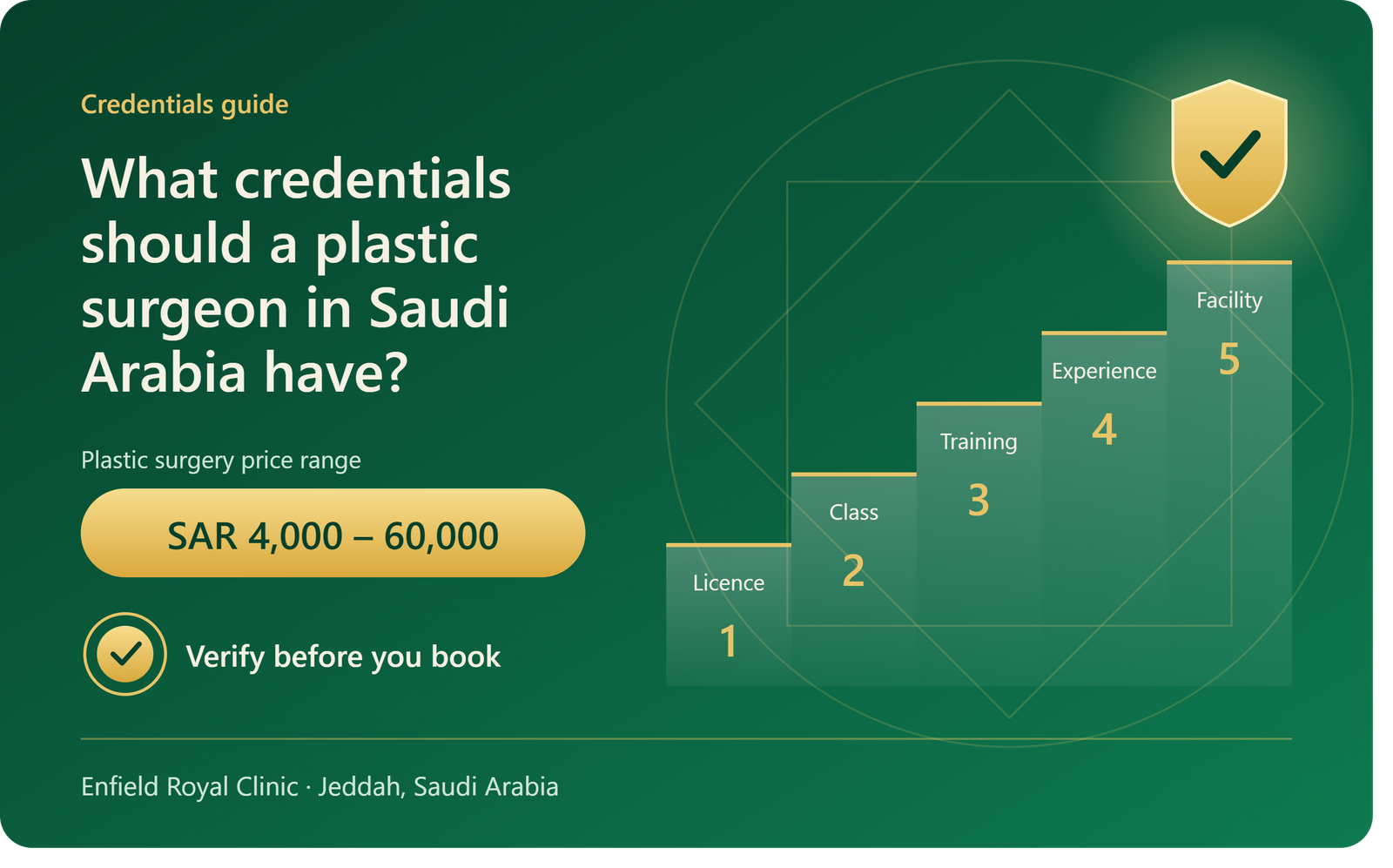
A plastic surgeon in Saudi Arabia should hold a valid registration with the Saudi Commission for Health Specialties, a professional classification that matches the specialty, recognized postgraduate training in plastic and reconstructive surgery, documented experience with your procedure, and work in a properly licensed facility. This guide treats credentials as five layers. Each layer answers one question, tells you what proof to request, and shows you where a gap should make you pause.
Why Credentials Come Before Price and Photos?
The clinic’s own Plastic Surgery in Jeddah page advises patients to verify the surgeon’s certification and read patient reviews. That sounds simple, but many patients do not know what certification means in practice. Credentials are the evidence that a surgeon was trained, assessed, and authorized to perform the operation you are considering. Photos and discounts say nothing about any of that, which is why verification should be your first step and not your last.
Is the Surgeon Registered to Practice?
Every health practitioner in the Kingdom should be registered with the Saudi Commission for Health Specialties, known as SCFHS. The Commission publishes professional classification and registration requirements on its practitioner pages, and runs Mumaris Plus, a unified portal for practitioner services across the Kingdom. scfhsscfhs
What proof looks like: a registration or license number and a classification that names the specialty. You can ask the clinic to show these documents, and a transparent clinic will not hesitate. If a surgeon cannot show a current registration, treat it as a serious red flag, however polished the clinic looks.
Does the Classification Match Plastic Surgery?
Registration alone does not tell you what a doctor is qualified to do. The classification shows the specialty and level of practice, for example whether someone is classified as a specialist or consultant. A general practitioner who performs cosmetic procedures is not the same as a trained plastic and reconstructive surgeon, even if both are licensed.
What proof looks like: a classification that explicitly lists plastic surgery or plastic and reconstructive surgery. Ask the question directly: “What is your classification, and in which specialty?”
Did the Surgeon Complete Recognized Specialist Training?
This layer separates trained plastic surgeons from everyone else. The Saudi Board is the Kingdom’s official postgraduate training pathway, managed by the Saudi Commission for Health Specialties since its establishment in 1992. According to the Saudi Board curriculum for the specialty, the plastic surgery program is six years of full-time supervised residency training in plastic surgery and its branches, at an institution accredited by the Commission. scfhsscfhs
That training covers more than cosmetic work. It includes reconstructive and other core areas of the specialty, which is why the title “Plastic and Reconstructive Surgeon” matters. Surgeons trained abroad may hold equivalent international qualifications, so ask to see the certificate and confirm how the surgeon is registered and classified in Saudi Arabia.
What proof looks like: a certificate from the Saudi Board in Plastic Surgery or an equivalent recognized qualification, along with the name of the training institution and year of completion. Do not accept vague descriptions like “trained internationally” or “certified in aesthetics” without a named, verifiable body behind them.
Does the Surgeon Have Experience With Your Procedure?
A qualified plastic surgeon may still focus on certain areas, so match the surgeon to your operation. The clinic’s price list shows the breadth of procedures a Plastic Surgery practice may handle:
| Procedure | Cost (SAR) |
|---|---|
| Rhinoplasty (nose surgery) | SAR 12,000 – 30,000 |
| Liposuction | SAR 10,000 – 30,000 |
| Tummy tuck (abdominoplasty) | SAR 18,000 – 40,000 |
| Breast augmentation | SAR 18,000 – 35,000 |
| Facelift surgery | SAR 20,000 – 45,000 |
Questions that reveal experience: how often do you perform this procedure, what complications have you managed, what results should I realistically expect, and when would you advise against operating? Honest, specific answers are a stronger signal than any number of years on a biography.
Is the Facility Licensed and Prepared?
A skilled surgeon still depends on a safe setting. The clinic describes a structured process: consultation and assessment, pre-surgical preparation with lab tests and medical screening, surgery with anesthesia and surgical markings for precision and symmetry, and immediate aftercare with scheduled follow-up. Surgery is performed under local or general anesthesia, depending on the treatment.
Ask where the operation takes place, whether the facility holds the required healthcare licenses, how anesthesia is handled, and how emergencies are managed. Every operation carries general surgical and anesthesia risks, and common effects include swelling, bruising, short-term discomfort, minor scarring, and temporary numbness. Infection is a recognized risk, so a well-prepared facility should be able to explain its prevention and response procedures.
The Surgeons Listed at Enfield Royal Clinic:
The clinic lists three Plastic and Reconstructive Surgeons on its plastic surgery page: Dr. Muhannad Ahmad, Dr. Mohamed Asem, and Dr. Mohamed Elnahas. It also lists Dr. Asmaa Abdel Raouf, a Dermatologist and Cosmetologist, who leads skin-focused and non-surgical care such as Botox and dermal fillers.
The page gives titles but does not publish qualifications, registration numbers, or years of experience. That is not a reason to assume anything about these surgeons, but it is a reason to ask. At your consultation, request each layer of proof above for the specific surgeon who will operate on you, and do the same at any clinic you consider.
A Credential Checklist to Bring to Your Consultation:
| What to verify | Proof to request |
|---|---|
| Registration | Current SCFHS registration or license number |
| Classification | A classification naming plastic surgery |
| Specialist training | Saudi Board certificate or recognized equivalent |
| Procedure experience | Clear answers about your specific operation |
| Facility | Licensing and an explained safety process |
| Price clarity | Written quote with inclusions |
Photograph or note each answer so you can compare surgeons later. A transparent clinic will welcome these questions, and a defensive response tells you something too.
Where Price Fits After Credentials?
Once credentials check out, compare costs. The clinic’s overall plastic surgery range is SAR 4,000 to SAR 60,000, and the exact price is confirmed only after a detailed consultation and treatment evaluation. The clinic names four factors behind the number: the type of procedure, the anesthesia type, pre- and post-operative tests, and the complexity of the case. Ask for a written quote showing what is included, including follow-up care and any revision policy.
What Recovery Expectations Say About a Surgeon?
Credible surgeons set realistic expectations. The clinic describes swelling and mild discomfort in the first days, initial healing in the first week, visible improvement in two to four weeks, most swelling subsiding by six to eight weeks, and final results becoming clearer between three and six months. Be cautious about any surgeon who promises instant or guaranteed perfect results.
Booking a Consultation:
The clinic advertises a 15% off offer and has a dedicated offers page. Ask which treatments qualify and what conditions apply. To start, complete the consultation form on the website, message the clinic on WhatsApp at +966 59 063 0187, or call +966 11 487 9071.
Frequently Asked Questions:
What credentials should a plastic surgeon in Saudi Arabia have?
A valid SCFHS registration, a classification in plastic surgery, recognized specialist training such as the Saudi Board or an equivalent, experience with your procedure, and a licensed facility.
How long is plastic surgery specialist training in Saudi Arabia?
The Saudi Board curriculum describes six years of full-time supervised residency training in plastic surgery and its branches.
How can I verify a surgeon’s registration?
Ask the clinic for the registration or license number and classification, and confirm them through the Commission’s official channels.
Are foreign-trained surgeons acceptable?
They can be, if their qualifications are recognized and they are registered and classified in Saudi Arabia. Ask to see the certificates.
How much does plastic surgery cost at this clinic?
The overall range is SAR 4,000 to SAR 60,000, with the exact price confirmed after consultation.
What is a red flag when checking credentials?
A surgeon who cannot show registration, avoids naming a training body, or pressures you to book before answering your questions.
Final Thoughts:
Credentials are the foundation of safe cosmetic surgery. Check registration, classification, specialist training, procedure experience, and the facility, then compare prices. Ask for proof at every layer, take notes, and decide only when the answers satisfy you.
