


Turkey Online Grocery Market: Demand Drivers and Future Outlook 2026-2034
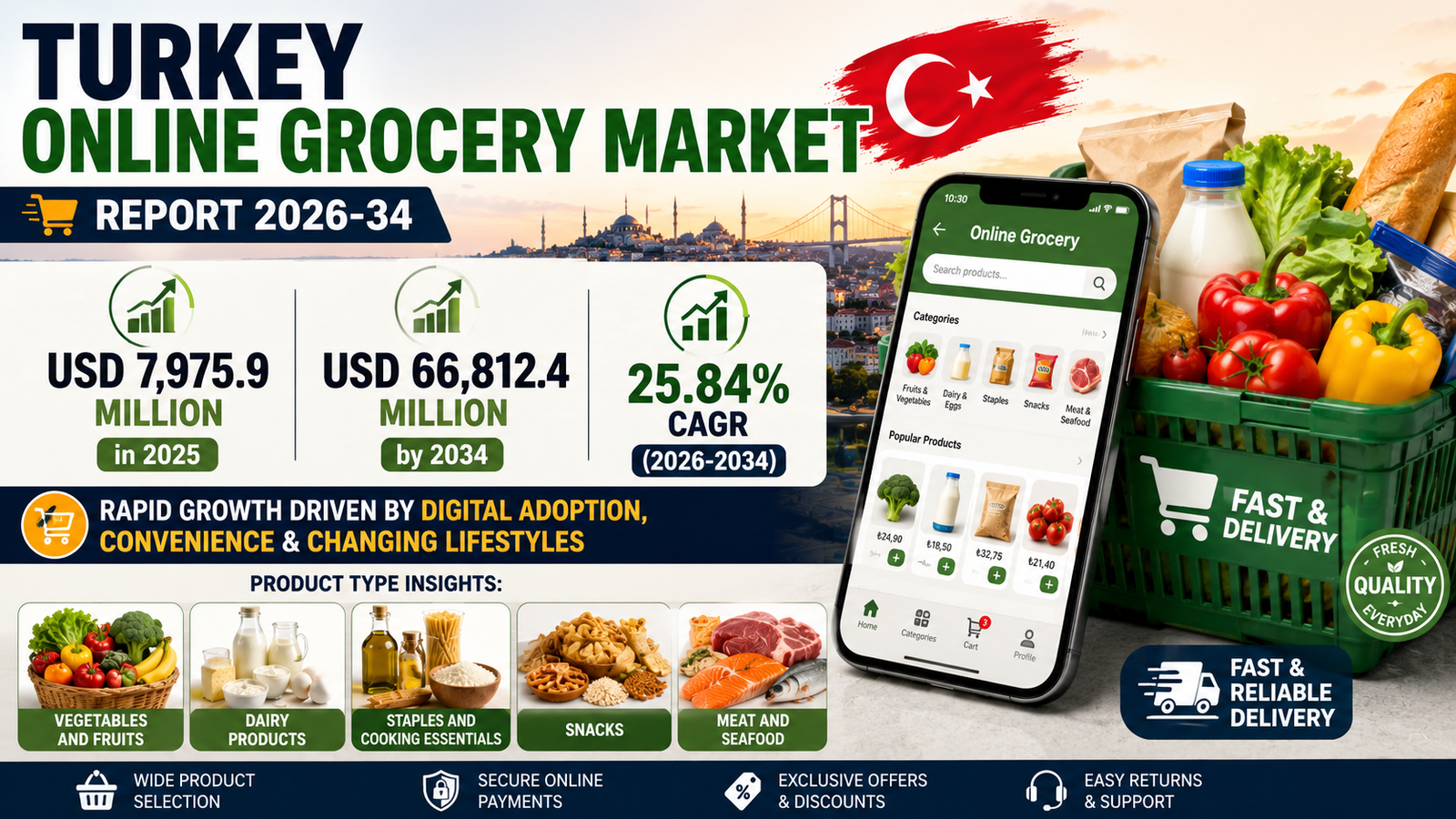
As per IMARC Group, a leading global market research and management consulting firm, has published its latest market intelligence report on the Turkey online grocery market size reached USD 7,975.9 Million in 2025. Looking forward, the market is projected to reach USD 66,812.4 Million by 2034, exhibiting a growth rate (CAGR) of 25.84% during 2026-2034, reflecting a rapid growth trajectory driven by urbanization, rising smartphone penetration, quick-commerce expansion, growing consumer preference for convenient shopping solutions, and strengthening digital payment infrastructure across the country.
The market is benefiting from a structural shift in how Turkish households source everyday essentials, moving away from traditional offline grocery trips toward app-based and web-based ordering channels. Retailers, quick-commerce startups, and established supermarket chains are competing intensely on delivery speed, product assortment, and loyalty incentives, while logistics investments in urban micro-fulfillment centers are shortening delivery windows for fresh produce, dairy, and packaged staples. This competitive intensity, combined with strong internet and mobile connectivity across the country, is positioning Turkey as one of the fastest-growing online grocery markets in the Europe-Middle East region.
How AI is Reshaping the Future of the Turkey Online Grocery Market?
- AI-Driven Demand Forecasting and Micro-Fulfillment Optimization: Quick-commerce and grocery platforms operating in Turkey are deploying machine learning models to predict hyperlocal demand patterns at the neighborhood level, allowing dark stores and micro-fulfillment centers to stock inventory more precisely, reduce spoilage of perishable categories such as fruits and dairy, and maintain delivery windows that are increasingly measured in minutes rather than hours.
- Personalized Recommendations and Dynamic Pricing Engines: Online grocery apps are using AI-powered recommendation engines to analyze past purchase history, browsing behavior, and basket composition, enabling personalized product suggestions, targeted discount campaigns, and dynamic pricing strategies that improve basket size and repeat purchase frequency among app-first younger consumers.
- Automated Fraud Detection and Secure Digital Payment Processing: As cash-on-delivery gives way to mobile wallets, contactless cards, and app-integrated payment systems, AI-based fraud detection and risk-scoring tools are being embedded into checkout systems to secure transactions in real time, reducing chargeback risk for merchants while reinforcing consumer confidence in cashless grocery payments.
Grab a sample PDF of this report: https://www.imarcgroup.com/turkey-online-grocery-market/requestsample
Turkey Online Grocery Market Trends and Drivers
Mobile commerce is a central driver of online grocery adoption in Turkey. Turkey has 80.7 million cellular mobile connections, representing 92.1% of the population, while internet users number 77.3 million, translating into an online penetration rate of 88.3%. This deep mobile connectivity is enabling grocery platforms to reach consumers directly through app-based ordering, push notifications, and loyalty programs, with younger, urban consumers increasingly favoring mobile-first shopping over traditional store visits.
Consumers are placing growing emphasis on delivery speed and reliability, particularly for fresh produce and daily essentials. Quick-commerce volume in the grocery and supermarket segment now accounts for close to a third of total quick-commerce order value in the country, reflecting how rapid, sub-hour delivery has shifted from a differentiator to a baseline expectation. Platforms are responding by expanding dark-store networks, densifying last-mile logistics, and forming partnerships with third-party delivery fleets in major metropolitan areas such as Istanbul, Ankara, and Izmir.
The shift toward mobile wallets, contactless cards, and app-integrated payment systems is reducing reliance on cash-on-delivery and streamlining checkout experiences. Government backing for cashless transactions, including the promotion of the domestic Troy payment scheme and continued digital transformation initiatives under the Ministry of Trade, is reinforcing consumer trust in digital payment rails. Retailers are compounding this shift by offering cashback incentives and discounts tied to digital payment methods, further accelerating the decline of cash-based grocery transactions.
Turkey Online Grocery Market Segmentation
The report has segmented the market into the following categories:
Breakup By Product Type:
- Vegetables and Fruits
- Dairy Products
- Staples and Cooking Essentials
- Snacks
- Meat and Seafood
- Others
Breakup By Business Model:
- Pure Marketplace
- Hybrid Marketplace
- Others
Breakup By Platform:
- Web-Based
- App-Based
Breakup By Purchase Type:
- One-Time
- Subscription
Breakup By Region:
- Marmara
- Central Anatolia
- Mediterranean
- Aegean
- Southeastern Anatolia
- Black Sea
- Eastern Anatolia
The Marmara region, home to Istanbul and the country's most densely populated and economically active urban centers, represents the largest regional market, supported by concentrated logistics infrastructure, high smartphone and internet penetration, and the presence of major quick-commerce dark-store networks.
Competitive Landscape
The report provides a comprehensive analysis of the competitive landscape in the Turkey online grocery market, with detailed profiles of key players active across marketplace, quick-commerce, and omnichannel grocery formats, including:
- Getir
- Trendyol (Trendyol Go)
- Migros
- CarrefourSA
- A101
- BIM
- Hepsiburada
- Yemeksepeti
- Glovo
- Tazedirekt
Recent News and Developments in the Turkey Online Grocery Market
- February 2026: Uber agreed to acquire Getir's delivery arm in Turkey, building on its existing Trendyol Go business; Getir's food delivery operations alone recorded gross bookings exceeding USD 1 Billion, up 50% year-on-year, underscoring the scale of consolidation underway in the country's quick-commerce sector.
- January 2026: Presidential Decree No. 10813 revised customs clearance procedures for business-to-consumer parcel imports, a regulatory change with direct implications for cross-border e-commerce flows and domestic grocery and quick-commerce fulfillment economics.
- November 2025: Turkey's Ministry of Trade held the country's first E-Commerce Week in Istanbul, spotlighting an e-commerce ecosystem supported by more than 601,000 registered sellers and reinforcing government engagement with digital retail infrastructure.
- June 2025: Trendyol, alongside ADQ, Ant International, and Baykar, signed a memorandum of understanding to build a broad-spectrum fintech platform aimed at serving both merchants and consumers, an initiative with direct relevance to digital grocery checkout and payment experiences.
- May 2025: Uber announced plans to acquire an 85% stake in Istanbul-based Trendyol Go for USD 700 Million, strengthening its footprint in Turkey's meal and grocery delivery market.
- June 2024: Getir announced a split into two independent companies after securing USD 250 Million in fresh investment, restructuring the business to sharpen its focus on Turkish operations while exiting European and United States markets.
Note: If you require specific details, data, or insights that are not currently included in the scope of this report, we are happy to accommodate your request. As part of our customization service, we will gather and provide the additional information you need, tailored to your specific requirements. Please let us know your exact needs, and we will ensure the report is updated accordingly to meet your expectations.
About Us:
IMARC Group is a global management consulting firm that helps the world's most ambitious changemakers to create a lasting impact. The company provides a comprehensive suite of market entry and expansion services. IMARC offerings include thorough market assessment, feasibility studies, company incorporation assistance, factory setup support, regulatory approvals and licensing navigation, branding, marketing and sales strategies, competitive landscape and benchmarking analyses, pricing and cost research, and procurement research.
Media and Sales Contact
IMARC Group
Email: sales@imarcgroup.com
United States: +1-201-971-6302
India: +91-120-433-0800
United Kingdom: +44-753-714-6104
