


Sustainability Advisory for Malaysian SMEs Entering Global Supply Chains
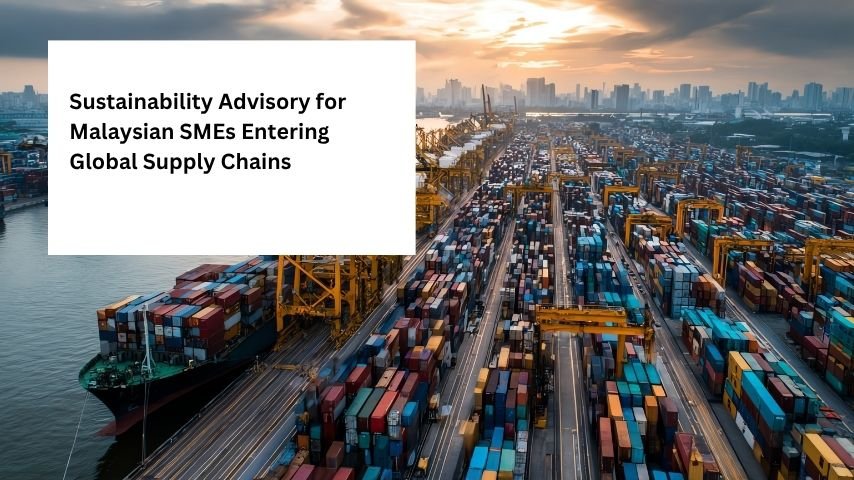
Sustainability advisory for Malaysian SMEs entering global supply chains helps smaller exporters meet the ethical trade, labor, and environmental due diligence standards that international buyers now require as a condition of doing business, even where the Malaysian SME itself carries no direct regulatory obligation under the foreign laws driving those requirements. As major economies introduce mandatory supply chain due diligence legislation — from Germany's Supply Chain Due Diligence Act to the EU's Corporate Sustainability Due Diligence Directive — the compliance burden these laws create is cascading down through global supply chains to reach exporters in Malaysia who may never have encountered this kind of scrutiny before. This article explains what is actually driving these new demands, what specific standards and audits Malaysian SMEs are being asked to meet, and how sustainability advisory helps smaller exporters respond without the compliance infrastructure of a large multinational.
Why Are Malaysian SMEs Suddenly Facing Global Supply Chain Sustainability Requirements?
Malaysian SMEs are facing global supply chain sustainability requirements because major buyer markets — particularly the European Union and Germany — have introduced binding legislation that holds large, in-scope companies legally responsible for human rights and environmental conditions across their entire supply chain, not just their own direct operations. The EU's Corporate Sustainability Due Diligence Directive (CSDDD) and Germany's Supply Chain Due Diligence Act (LkSG) mandate this kind of due diligence for large companies, and while SMEs are not directly regulated by these laws themselves, their large customers must ensure suppliers meet the same standards, which cascades down as increased information requests, stricter contract terms, and greater pressure to align with compliance expectations (Sedex, 2026).
This cascading effect means a Malaysian SME supplying an EU-based buyer in Germany, France, or the Netherlands is increasingly expected to demonstrate verified ethical compliance, even though the SME itself sits entirely outside the direct legal scope of these regulations (Alibaba.com Seller Blog, 2026). For SMEs unfamiliar with this dynamic, the sudden appearance of detailed supplier questionnaires or audit requirements can seem disconnected from any Malaysian law, since the actual legal driver originates in the buyer's home jurisdiction rather than in Malaysia.
Does This Mean Malaysian SMEs Are Legally Bound by EU or German Law?
No, Malaysian SMEs are not legally bound by EU or German supply chain due diligence law directly, since these regulations apply to the large, in-scope companies based in or selling into those markets, not to their overseas suppliers. However, being unprepared for these expectations can still damage a Malaysian SME's business relationships and market access, since non-compliance with a buyer's own due diligence obligations may lead that buyer to seek suppliers who can more easily provide the assurance it legally needs (Sedex, 2026).
What Specific Audit Standards Are Malaysian SMEs Being Asked to Meet?
Malaysian SMEs entering global supply chains are most commonly being asked to hold a valid Sedex Members Ethical Trade Audit (SMETA), the world's most widely used social audit methodology, covering labor standards, health and safety, environmental performance, and business ethics at a given production site. Major retailers, brands, and original equipment manufacturers increasingly request SMETA reports as a condition of doing business, particularly in sectors such as textiles and apparel, electronics, consumer goods, food and beverage, agriculture, and packaging (DQS Global, n.d.).
It is worth understanding precisely what a SMETA audit represents: it functions as an informational and due diligence tool rather than a formal certification, meaning its purpose is to promote transparency and facilitate a buyer's own due diligence process rather than to formally endorse or guarantee compliance on the supplier's behalf (TÜV SÜD, n.d.). More than 540,000 SMETA audits have been conducted globally, with roughly 180,000 non-conformities closed in 2024 alone, reflecting both the scale of adoption and the practical corrective work these audits typically generate (Alibaba.com Seller Blog, 2026).
What Does a SMETA Audit Actually Involve for a Malaysian Supplier?
A SMETA audit for a Malaysian supplier typically involves an on-site assessment conducted by an APSCA-certified auditor with expertise in regional labor law and health and safety regulations, lasting one to three days depending on facility size and audit scope, with the audit type available in either a two-pillar (labor and health and safety) or four-pillar (adding environment and business ethics) format (QIMA, n.d.). Following the audit, the supplier receives a corrective action plan identifying specific gaps that need to be addressed, which the supplier is then expected to close within an agreed timeframe.
What Practical Benefit Does a SMETA Audit or Similar Certification Provide a Malaysian Exporter?
A SMETA audit provides a Malaysian exporter with a single, standardized report that can be shared with multiple buyers simultaneously, reducing the need to undergo separate, duplicative audits for each individual customer requiring ethical trade assurance. Suppliers report meaningfully fewer duplicate audits once a SMETA report is uploaded to the Sedex platform and shared across their buyer relationships, and some markets report up to 40% fewer buyer audits following registration with the scheme (DQS Global, n.d.; JS Certification, 2026).
Beyond reducing audit duplication, a valid SMETA audit or comparable ethical trade certification can directly determine market access: suppliers without one may be excluded from approved vendor lists altogether, limiting sourcing options and disrupting supply continuity for buyers who require this level of assurance (QIMA, n.d.). For a Malaysian SME seeking to enter or expand within global supply chains serving UK, EU, or US retailers, holding this kind of independently verified audit is increasingly treated as a baseline commercial requirement rather than an optional differentiator.
Is a SMETA Audit the Only Option Available to Malaysian SMEs?
No, a SMETA audit is not the only option, since Sedex and other platforms accept various recognized social audit methodologies to maximize coverage, and buyers may specify a different but comparable ethical trade audit depending on their own sourcing policy or industry sector. What matters most to a buyer is typically independent, third-party verification of working conditions and ethical practices rather than a single named audit scheme specifically, though SMETA's widespread adoption makes it the most commonly requested option across many sectors and markets.
How Does Sustainability Advisory Help Malaysian SMEs Prepare for These Audits and Requirements?
Sustainability advisory helps Malaysian SMEs prepare for ethical trade audits and buyer due diligence requirements by conducting a pre-audit gap analysis against the specific standard a buyer requires, identifying labor practice, health and safety, environmental, or governance issues before an independent auditor finds them, and helping the SME implement corrective actions in advance rather than reacting to findings during a live audit process. Investing in preparation before an audit generally reduces the overall cost of certification by minimizing the number of corrective actions and follow-up visits required afterward (ECQA, 2025).
This advisory work often extends beyond the audit itself into ongoing supplier relationship management, since buyers increasingly expect suppliers to demonstrate continuous improvement rather than a one-time pass on an initial audit. Sustainability advisors such as Wellkinetics help Malaysian SMEs build the internal record-keeping, policy documentation, and worker communication practices needed to sustain compliance between audit cycles, rather than treating each audit as an isolated event requiring last-minute preparation.
Can Sustainability Advisory Help an SME Respond to a Buyer's Own Compliance Questionnaire, Not Just a Formal Audit?
Yes, sustainability advisory can help an SME respond to a buyer's own compliance questionnaire or code of conduct assessment, which is often a lighter-weight but still meaningful requirement compared to a full third-party audit. Many large buyers use standardized supplier engagement tools to collect information, share expectations, and track supplier improvement over time, and an advisor familiar with these tools can help an SME respond accurately and completely rather than submitting incomplete or inconsistent information across different buyer relationships (Sedex, 2026).
How Does This Cascading Compliance Pressure Interact With Malaysia's Own ESG Reporting Framework?
This cascading compliance pressure interacts with Malaysia's own domestic ESG reporting framework because a Malaysian SME responding to a foreign buyer's ethical trade or environmental due diligence request may find that the underlying data — labor records, emissions data, governance documentation — overlaps substantially with what it would need to prepare under Malaysia's own Simplified ESG Disclosure Guide, designed specifically for SMEs sitting within the supply chains of Bursa Malaysia-listed issuers. An SME facing both a domestic listed customer's ESG data request and a foreign buyer's ethical trade audit requirement can often build a single, coordinated set of underlying documentation and data that serves both purposes, rather than responding to each request as an entirely separate exercise.
Sustainability advisors working with Malaysian SMEs increasingly help structure this kind of coordinated response, recognizing that domestic and international supply chain pressures are converging on largely the same underlying evidence — accurate labor records, environmental data, and governance documentation — even though the specific forms, audits, and frameworks requesting that evidence differ.
Should a Malaysian SME Prioritize Domestic ESG Requests or Foreign Buyer Audits First?
A Malaysian SME should prioritize whichever request carries the more immediate commercial consequence — typically, a foreign buyer's ethical trade audit requirement, since failing it can result in exclusion from an approved vendor list and immediate loss of business, whereas a domestic listed customer's ESG data request, while important, more often results in a documentation gap being flagged for future improvement rather than immediate commercial exclusion. That said, both pressures are converging over time, and an SME building genuinely robust underlying compliance data will find it increasingly serves both purposes regardless of which pressure arrives first.
What Are the Common Criticisms of How This Compliance Burden Is Distributed?
The most common criticism of how supply chain sustainability compliance burden is distributed is that large buyers and the regulations driving their behavior effectively transfer significant compliance costs onto smaller suppliers who had no role in shaping the underlying legislation and often lack the resources to absorb repeated audit and documentation costs across multiple buyer relationships. Critics specifically note that SMEs facing several different buyers, each with slightly different audit or reporting requirements, can end up spending disproportionate resources on compliance overhead relative to their scale, even when a single, coordinated underlying compliance effort would suffice.
Defenders of the current system point to platforms such as Sedex specifically reducing this duplication by allowing a single audit report to be shared across multiple buyer relationships, and to industry data showing measurable reductions in duplicate audits following registration with such systems. The more balanced view is that while the underlying compliance burden genuinely originates from regulation and buyer expectations outside an SME's control, standardized audit platforms and coordinated advisory support meaningfully reduce — though do not eliminate — the disproportionate cost smaller suppliers would otherwise face navigating each buyer relationship independently.
How Should Malaysian SMEs Approach Sustainability Advisory as They Expand Into New Export Markets?
Malaysian SMEs should approach sustainability advisory proactively as they expand into new export markets, engaging support to understand which specific due diligence standards, audits, or certifications their target buyers and markets are likely to require before those requirements arrive as an urgent, deal-threatening demand. An SME entering a new relationship with a German or broader EU buyer, for instance, benefits from understanding upfront that ethical trade audits such as SMETA are increasingly treated as a baseline expectation rather than negotiating this requirement only after losing an initial opportunity to a better-prepared competitor.
Building this compliance capability incrementally, starting with the most commonly requested standards in the SME's specific sector, tends to be more sustainable than attempting to achieve every possible certification simultaneously, particularly given the genuine resource constraints most Malaysian SMEs operate under compared to the large multinational buyers driving these requirements.
Conclusion
Malaysian SMEs entering global supply chains now face a genuine, cascading compliance burden originating from foreign legislation such as the CSDDD and LkSG, even though these laws do not directly regulate the SMEs themselves, and standardized audits such as SMETA have become a practical baseline expectation for accessing many international buyer relationships. Sustainability advisory helps Malaysian SMEs meet this rising bar efficiently — preparing for audits proactively, coordinating domestic and foreign compliance data into a single underlying evidence base, and prioritizing the requirements most likely to affect near-term market access — rather than treating each new buyer relationship as an isolated compliance challenge to solve from scratch.
References
- Alibaba.com Seller Blog. (2026, May). SEDEX ethical trade certification: Your complete 2026 guide for apparel exports. https://seller.alibaba.com/blogs/2026/southeast-asia/apparel/sedex-ethical-certification-guide-alibaba-b2b
- DQS Global. (n.d.). Sedex SMETA audit. https://www.dqsglobal.com/en/certify/sedex-smeta-audit
- ECQA. (2025, September). Sedex SMETA audit: Complete guide to ethical trade compliance. https://ecqa.com/sedex-smeta-audit-complete-guide-to-ethical-trade-compliance/
- JS Certification. (2026, April). SMETA audit & Sedex certification services. https://jscertification.com/sedex-smeta-audit-certification/
- QIMA. (n.d.). SMETA audit & Sedex audit. https://www.qima.com/consumer-products/smeta
- Sedex. (2026, February). Corporate Sustainability Due Diligence Directive (CSDDD) compliance guide. https://www.sedex.com/blog/what-business-need-to-know-about-the-corporate-sustainability-due-diligence-directive-csddd/
- Sedex. (2026, March). Corporate Sustainability Due Diligence Directive. https://www.sedex.com/why-sedex/comply-with-legislation/corporate-sustainability-due-diligence-directive/
- TÜV SÜD. (n.d.). SMETA audit - Sedex Members Ethical Trade Audit. https://www.tuvsud.com/en-us/services/auditing-and-system-certification/sedex-smeta
