


Why Does a Camera Struggle to Autofocus Through Car Windows?
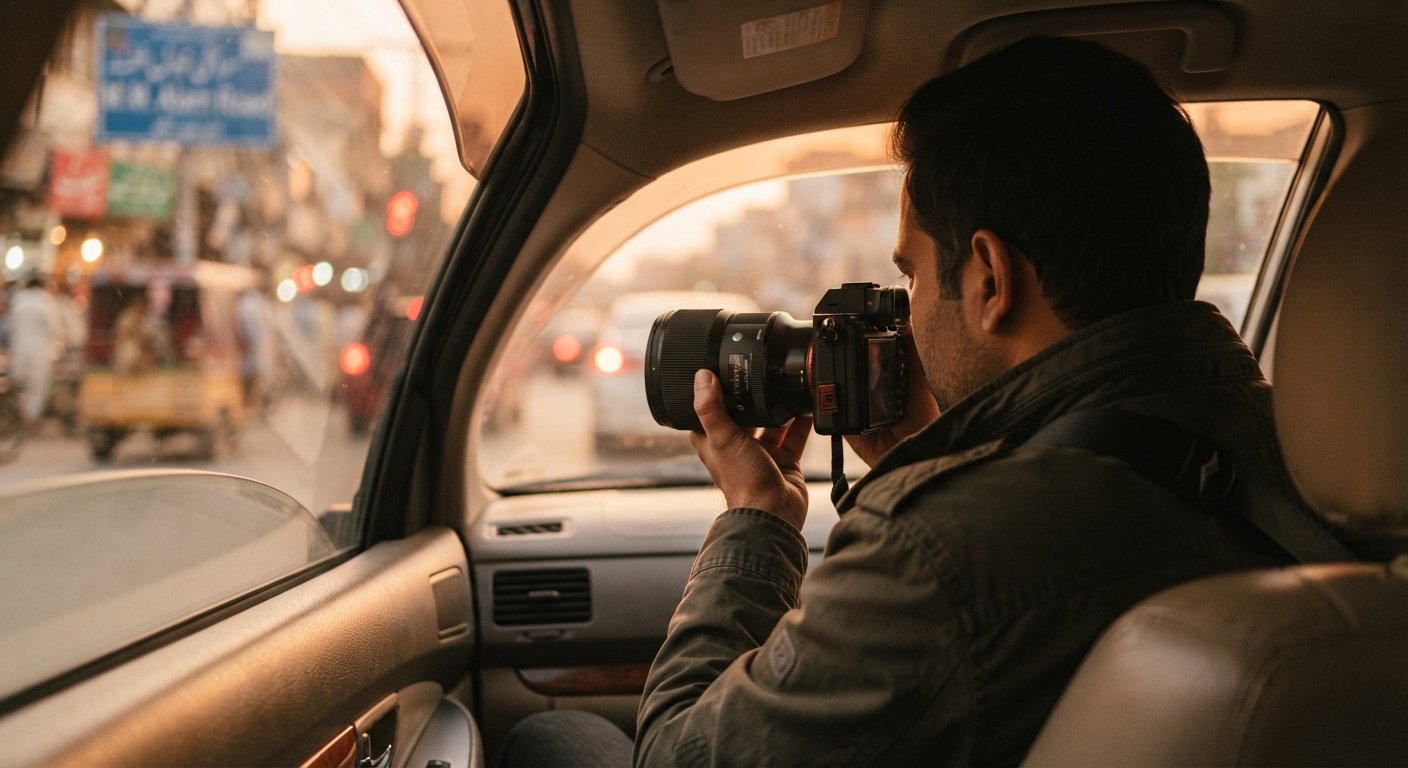
If your camera hunts, refuses to lock, or focuses on the wrong thing every time you try to shoot through a car window, the glass itself is almost always the reason — not a fault in your camera or lens. Car windows are curved, tinted, often dusty or streaked, and highly reflective, and every one of those properties actively works against how autofocus systems are designed to function. Add motion from a moving vehicle and you get a combination that frustrates even experienced shooters covering wedding convoys, street photography, or drive-by event coverage.
This guide breaks down exactly what's happening optically and mechanically when you try to focus through glass, why some situations are worse than others, and what actually works to get a usable shot — whether you're shooting a baraat procession from inside a decorated car, catching candid street moments from a moving vehicle, or photographing wildlife and landscapes from inside a safari jeep in the north.
What Actually Happens When You Autofocus Through Glass?
Autofocus systems — whether contrast-detection, phase-detection, or the hybrid systems in modern Sony, Canon, and Nikon mirrorless bodies — work by analyzing contrast and edge detail in the scene to determine correct focus distance. Glass interferes with this in three separate ways at once, which is why the problem feels so persistent.
First, glass reflects. Even clean, untinted glass reflects a portion of the light hitting it, layering a faint mirror image of whatever is behind the camera — your own reflection, the car's interior, the sky — on top of the scene you're trying to shoot. Autofocus systems often lock onto this reflection layer instead of the subject beyond the glass, especially in contrasty light where the reflection has stronger edges than the softer subject outside.
Second, glass refracts and can introduce slight optical distortion, particularly car windows, which are rarely flat — they're subtly curved to fit the vehicle's body design. This curvature bends light unevenly across the frame, which can confuse phase-detection AF points that expect a straight optical path.
Third, most vehicles in Pakistan run tinted windows, which cut both visible light and contrast. Lower light and lower contrast are the two conditions autofocus systems perform worst in, so tinted glass compounds the reflection and curvature problems with a straightforward loss of the detail AF needs to lock onto.
Real scenario: Shooting a baraat car procession in Lahore through the vehicle's rear window with a Sigma 24-70mm DG DN on a Sony body, autofocus repeatedly locked onto raindrop streaks and window reflections rather than the couple inside, even with a single, centered AF point selected. Switching to manual focus with focus peaking, and physically angling the lens slightly off perpendicular to the glass to reduce direct reflection, resolved the lock issue within two attempts.
Does the Angle You Shoot at Actually Matter?
Yes, more than most photographers expect. Shooting straight through a window, perpendicular to the glass, maximizes reflection, because you're looking directly back at whatever light source is behind you — often your own shadow, the sky, or interior cabin light. Shooting at an angle redirects that reflected light away from your lens instead of straight back into it, which is the same principle behind why polarizing filters and sunglasses cut glare at oblique angles better than head-on ones.
|
Shooting Angle to Glass |
Reflection Level |
Autofocus Reliability |
Best Use Case |
|
Perpendicular (90°) |
Highest |
Poor — AF often locks on reflection |
Avoid unless glass is exceptionally clean and shaded |
|
Slight angle (15–30° off) |
Moderate |
Improved — some reflection control |
General street/event shooting through windows |
|
Steep angle (45°+) |
Lowest |
Best AF reliability |
Ideal when composition allows, though framing gets harder |
|
Lens pressed directly to glass |
Minimal (blocks external reflections) |
Best overall, but limited to static subjects |
Static subjects only — impractical for moving vehicles |
Real scenario: Photographing Karakoram Highway scenery from inside a hired 4x4 near Skardu, shots taken straight through the side window showed heavy reflection of the vehicle's dashboard and the photographer's own gear. Repositioning to shoot at a steeper angle toward the front windshield corner, where less direct light was bouncing back, produced a noticeably cleaner frame with autofocus locking correctly on the mountains rather than the interior reflection.
Why Do Autofocus Points Sometimes Lock onto Dust or Water Spots Instead of the Subject?
Contrast-detection and phase-detection systems are both drawn to the highest-contrast edges within their selected AF area. A dust speck, water droplet, or fingerprint smudge on glass creates a small, sharp, high-contrast edge sitting much closer to the lens than your actual subject — and autofocus systems will frequently prioritize that close, sharp edge over a softer, more distant subject, especially in single-point or wide-area AF modes that aren't told exactly where to look.
This is a bigger issue in Pakistan than in many markets simply because of road dust, monsoon-season water spotting, and the fact that most vehicle windows aren't cleaned to studio-glass standards between shoots.
Real scenario: During a monsoon-season shoot through a car window in Islamabad, persistent AF hunting turned out to be the camera locking onto a cluster of dried raindrop spots on the outer glass rather than the pedestrian subject across the street. Wiping the glass — both interior and exterior surfaces — eliminated the hunting immediately, without any change to camera settings.
What helps:
-
Physically clean both sides of the glass before a planned shoot, not just the side facing you
-
Use single-point AF and manually place that point directly on your subject rather than relying on wide-area or tracking modes, which are more likely to grab a closer, sharper artifact
-
If dust or spotting can't be cleaned in the moment (a moving vehicle, a rented car), manual focus with peaking is more reliable than fighting autofocus repeatedly
Manual Focus vs Autofocus Through Glass: Which Actually Works Better?
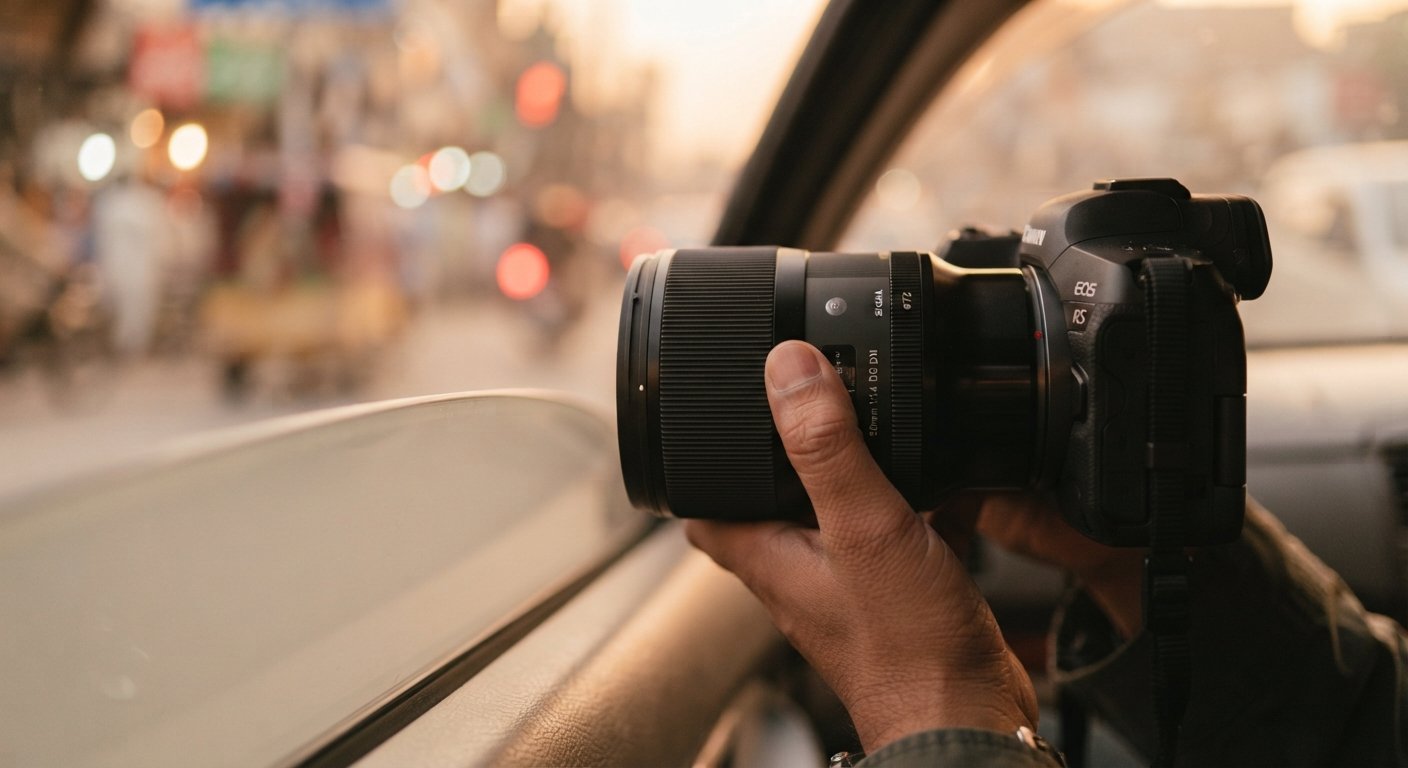
For static or slow-moving subjects, manual focus consistently outperforms autofocus through glass, because it removes the guesswork entirely — you decide what's sharp instead of asking the camera to interpret a confusing, reflective, curved surface. For fast-moving subjects shot from a moving vehicle, though, manual focus becomes difficult to keep accurate, and a well-configured autofocus system with the right settings often wins simply because it can react faster than a hand can adjust focus ring position.
|
Approach |
Strength |
Weakness |
Best For |
|
Autofocus (single-point, subject-placed) |
Fast reaction, good for moving subjects |
Prone to locking on reflections/dust if point isn't precisely placed |
Moving vehicles, fast street photography, events |
|
Autofocus (wide-area/tracking) |
Convenient, hands-off |
Most likely to grab reflections or spots instead of subject |
Not recommended for glass — highest failure rate |
|
Manual focus with peaking |
Full control, ignores glass artifacts |
Slower, harder with a moving subject or vehicle |
Static subjects, planned compositions, portraits through glass |
|
Manual focus, pre-set to a fixed distance |
Very reliable for repeated similar shots |
Requires the subject to stay at a consistent distance |
Repeated shots of the same scene type (e.g., toll booths, drive-throughs) |
Real scenario: Shooting candid portraits of a bride inside a decorated car ahead of a Lahore wedding, switching from continuous autofocus to manual focus with peaking, pre-set to the approximate distance of the seated subject, produced a far higher keeper rate across a ten-minute shoot than autofocus had managed in the first two minutes of hunting.
Does Lens Choice Make a Difference When Shooting Through Glass?
Lens choice matters less than technique here, but it isn't irrelevant. Lenses with faster, more confident autofocus motors — particularly Sigma's DG DN Art and Contemporary lines built for native mirrorless mounts — tend to hunt less aggressively than older, slower-focusing designs when faced with the low-contrast conditions glass creates, simply because they can rack through the full focus range and re-evaluate faster. However, no lens autofocus system, regardless of brand or price, is immune to reflection or curvature confusion. A premium telephoto will still struggle with a heavily tinted or dirty window exactly like a budget kit lens would, because the problem originates at the glass, not inside the lens.
Wider apertures do help in one specific way: a wide aperture like f/1.8 or f/2.8 creates a shallower depth of field, which can help throw a dirty or reflective glass surface further out of focus relative to your subject if you deliberately focus well beyond it — though this only works when the glass is close to the lens and the subject is meaningfully farther away, which is typically the case in car-window shooting.
Comparing the Core Problem Sources
|
Cause |
What Causes It |
How to Recognize It |
Fix |
|
Reflection |
Shooting perpendicular to glass, bright light behind camera |
AF locks on your own reflection or interior elements |
Shoot at an angle, shade the lens with your body/hand |
|
Curvature/refraction |
Naturally curved automotive glass |
Slight softness or AF confusion near frame edges |
Center subject more, avoid extreme wide-angle through glass |
|
Tint |
Aftermarket or factory window tinting |
Low contrast, AF hunting in anything but bright light |
Shoot in brighter conditions, raise ISO rather than fighting AF in dim tint |
|
Dust/water spots |
Road dust, monsoon rain, fingerprints |
AF snaps to a spot closer than your subject |
Clean glass beforehand, use single-point AF placed precisely |
The Practical Takeaway
Autofocus struggling through car windows is almost never a lens or camera defect — it's the glass fighting the very things autofocus relies on: contrast, a clear optical path, and an unambiguous subject to lock onto. Before your next shoot through glass, run through the basics: clean both sides of the window if you can, shoot at an angle rather than straight-on to cut reflection, and switch to single-point AF placed precisely on your subject instead of trusting wide-area tracking. If the subject is static or slow-moving, manual focus with peaking will usually outperform autofocus entirely. None of this requires new gear — it just requires recognizing that the glass, not your camera, is the variable you're fighting.
Frequently Asked Questions
Can a polarizing filter fix autofocus problems through car windows?
A polarizing filter reduces certain reflections and glare, which can indirectly help autofocus by improving contrast on your actual subject rather than a reflection. It won't fix issues caused by dust, tint, or glass curvature, and it isn't a complete solution, but it's a useful addition when reflection is the main problem.
Why does my camera focus on my own reflection instead of the subject outside?
This happens because your reflection is often closer to the lens and has sharper, higher-contrast edges than the subject beyond the glass, and autofocus systems are designed to prioritize strong contrast. Shooting at an angle to the glass or shading the lens with your hand reduces this reflection significantly.
Is it better to roll the window down instead of shooting through it?
Yes, whenever possible — shooting through an open window eliminates every glass-related autofocus issue entirely, since there's no reflective or curved surface involved. This is the simplest fix and should be the first option considered before troubleshooting autofocus settings.
Does tinted glass make autofocus worse than clear glass?
Yes, tinted glass reduces both light and contrast reaching the lens, and autofocus systems perform worse in low-light, low-contrast conditions regardless of brand or lens quality. Factory tint is usually less problematic than dark aftermarket tint, which is common on private vehicles in Pakistan.
What autofocus mode works best for shooting through a car window?
Single-point AF, manually positioned directly on your subject, generally outperforms wide-area or tracking modes when shooting through glass, since it prevents the camera from choosing a closer reflection or dust spot on its own. For static subjects, manual focus with focus peaking is often more reliable than any autofocus mode.
