


Can FUE Hair Transplant in Dubai Work With Curly Hair Types?
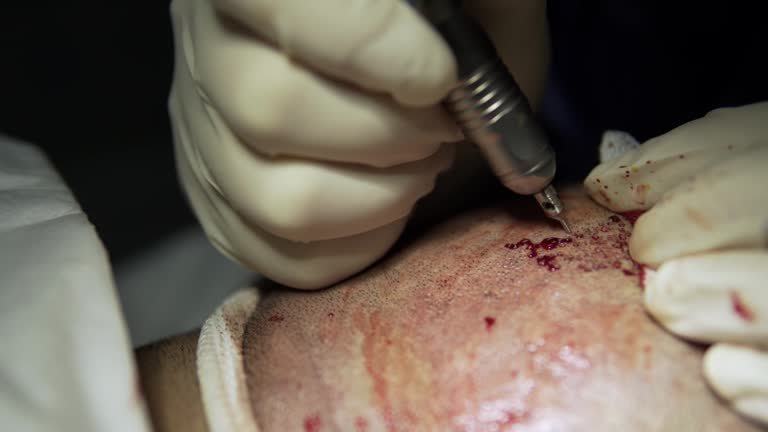
Curly and tightly curled hair can be suitable for transplantation, but the follicle's shape beneath the scalp requires particularly careful assessment. For appropriate candidates, FUE Hair Transplant in Dubai can restore thinning areas using individual follicular units, with extraction and implantation planned around the patient's natural curl pattern.
The key challenge is not the visible curl alone. Curved hair shafts can correspond with follicles that change direction beneath the skin, making punch alignment and graft handling important during extraction.
Why Curly Hair Requires Specialized FUE Planning
Straight hair generally provides a more predictable relationship between the visible shaft and the follicle beneath the scalp. With curly hair, the follicle may curve or change trajectory below the surface.
The Visible Hair Does Not Show the Entire Follicle Path
A curly strand can emerge from the scalp in one direction while the follicle follows a curved path underneath. A punch introduced without accounting for that trajectory may increase the risk of transecting the follicular unit.
This makes preoperative examination particularly important for patients with strong curl patterns.
Curl Pattern Can Vary Across the Scalp
Not every donor follicle necessarily has identical curvature. Hair may also differ between the central donor zone and the lateral areas.
The extraction approach therefore needs to be adapted to the individual's anatomy rather than assuming one angle applies throughout the donor region.
How the Donor Area Is Evaluated
A curly-haired patient should receive the same fundamental donor assessment as any other FUE candidate, with additional attention to follicular orientation and curvature.
Density and Hair Caliber
The specialist evaluates donor density, shaft thickness, follicular grouping, and the width of the stable donor region. These characteristics influence how much visual coverage can potentially be created.
Curly hair can sometimes provide substantial visual volume because its shape occupies more space than a straight strand of similar diameter, but this should be assessed rather than assumed.
Follicular Orientation
Magnified examination can help identify how individual follicles emerge and how their paths may differ beneath the scalp. This information can guide punch positioning during extraction.
Understanding the three-dimensional follicular trajectory is particularly important when the hair has a pronounced curl.
Can FUE Extract Curly Follicles Safely?
FUE can be performed on curly hair, but extraction requires careful alignment with the follicle. The punch should follow the anticipated follicular path as closely as possible to reduce unnecessary damage.
Punch Alignment Matters
The angle visible at the scalp surface may not accurately represent the complete subcutaneous direction of a curved follicle. The operator must account for this when positioning the extraction device.
Technical precision becomes especially important when the curl is tight or the follicle changes direction significantly below the skin.
Graft Transection Is a Key Consideration
Transection occurs when a follicular unit is cut or damaged during extraction. Curved follicles can present additional technical challenges because their pathway may not correspond directly to the visible hair shaft.
Careful donor mapping and experienced extraction technique can help reduce unnecessary follicular injury.
How Curly Hair Changes Graft Handling
After extraction, follicular units must be kept viable while they are prepared for implantation. Curly grafts can appear compact or irregular compared with straight-hair grafts.
Grafts Need Careful Identification
A follicular unit may contain several curved hairs that overlap or coil around one another. The team must identify the graft correctly and avoid excessive manipulation during preparation.
Unnecessary handling can place mechanical stress on the follicular structures.
Orientation During Implantation Matters
The final result should reproduce the natural emergence and direction of the patient's hair. The surgeon needs to consider how the curl will develop as the transplanted hair grows through the recipient scalp.
This is particularly relevant along visible boundaries such as the frontal hairline.
Curly Hair and Hairline Design
The hairline requires a soft transition from forehead to scalp. Curly hair can create a visually dense appearance even when follicular spacing is relatively modest.
Single-Hair Units Can Create a Natural Edge
Finer single-hair follicular units are commonly useful toward the leading edge because they create a softer transition. Their orientation should follow the natural direction of the patient's own frontal hair.
Density Should Reflect the Curl Pattern
Because curly hair can create more visual coverage through its three-dimensional shape, simply matching the numerical density of straight hair may not be necessary.
The surgeon should consider actual visual coverage rather than relying only on graft counts.
Can Curly Hair Be Used to Restore the Crown?
Yes, when the donor supply and recipient area are suitable. However, the crown adds another layer of complexity because hair direction changes around the vertex.
The Natural Whorl Still Needs to Be Recreated
Curly hair must follow the patient's existing crown pattern rather than being placed in a uniform orientation. Recipient sites should account for the changing direction around the whorl.
Curl Can Influence Visual Coverage
The three-dimensional shape of curly hair may help obscure scalp visibility, but this varies significantly between individuals. Hair diameter, curl tightness, density, and length all affect the final visual effect.
Does Curly Hair Make a Transplant Look More Natural?
Naturalness depends on more than hair texture. It is influenced by follicular placement, angle, direction, density transitions, donor-recipient matching, and the patient's original growth pattern.
Texture Matching Is Important
When possible, donor follicles should be appropriate for the recipient area. Differences in texture between donor and native hair should be considered when designing the restoration.
Curl Can Help Blend Grafts
Once fully grown, naturally curly hair can create visual overlap between individual strands. This may help soften the appearance of the transition between transplanted and native hair.
However, this should not be treated as a guarantee because curl characteristics differ from person to person.
Curly Hair and Limited Donor Supply
Curly hair does not eliminate the need for donor conservation. The number of usable follicles remains finite, regardless of how much visual coverage the hair texture provides.
Visual Coverage and Follicle Numbers Are Different
A patient with curly hair may achieve substantial apparent coverage from fewer visible strands than someone with very straight hair. Nevertheless, the number of transplantable follicular units is still determined by donor anatomy.
This distinction becomes important when planning larger restorations.
Future Hair Loss Still Matters
If native hair outside the transplanted area is susceptible to continued thinning, the available donor supply may eventually need to address additional regions.
Long-term planning should therefore consider the patient's entire pattern of hair loss rather than relying on curl-related visual coverage.
Women With Curly Hair Can Also Be Candidates
Curly hair transplantation is not limited to men. Women with suitable donor characteristics may also be considered for FUE when localized or patterned thinning creates an appropriate recipient area.
Female Hair Loss Requires Its Own Assessment
Diffuse thinning is common in female pattern hair loss, and donor density may also be affected. The clinician should establish whether there is enough stable donor hair and whether transplantation is likely to provide meaningful improvement.
Styling Patterns Can Affect Planning
Curly hair is often worn at different lengths or with specific styling techniques. These preferences should be discussed because they influence how visible the donor and recipient areas may be during recovery.
When FUE May Need Extra Caution With Curly Hair
Curly hair itself is not necessarily a contraindication, but certain anatomical or donor characteristics can make extraction more technically demanding.
Very Tight Curl Patterns
The tighter the follicular curvature, the more important accurate donor assessment becomes. Deeply curved follicles can be more challenging to follow with a punch.
Previous Procedures
Patients who have undergone earlier hair transplantation may have altered donor anatomy or scar tissue. The extraction strategy should account for previous procedures rather than treating the donor region as untouched.
Low Donor Density
If the donor region already contains limited follicular supply, the additional technical demands of curved follicles make careful planning even more important.
Recovery After FUE for Curly Hair in Dubai
Postoperative care is broadly similar regardless of hair texture, although curly hair may make gentle washing and styling more important during the early period.
Patients should avoid pulling, twisting, brushing, or manipulating the newly implanted grafts according to their surgeon's instructions. Styling products should also be avoided until the clinical team confirms they are appropriate.
Dubai's intense sunlight and high outdoor temperatures add another consideration. Patients should protect the healing scalp according to their postoperative instructions and temporarily limit activities that produce excessive heat, sweating, or direct sun exposure.
What Patients in Dubai Should Do Next
Patients with curly or tightly curled hair should seek an assessment that examines the donor follicles beneath the visible hair pattern, not just surface density.
The consultation should evaluate follicular curvature, donor density, hair caliber, curl characteristics, recipient anatomy, existing native hair, and the long-term restoration plan. A personalized FUE hair restoration assessment can help determine whether the patient's curl pattern is compatible with transplantation and how extraction should be approached.
Questions to ask include:
Can people with curly hair have FUE?
Yes. Curly hair can be transplanted when the donor and recipient characteristics are suitable.
Is FUE harder with curly hair?
The curved follicular path can make extraction technically more demanding and requires careful punch alignment.
Can curly donor hair be used for a straight-haired recipient area?
It may be possible in selected cases, but texture differences should be considered during treatment planning.
Does curly hair require more grafts?
Not necessarily. Visual coverage depends on curl, caliber, density, hair length, and recipient characteristics rather than graft count alone.
The Strategic Investment
Curly hair can be compatible with FUE, but the follicle beneath the scalp deserves as much attention as the visible curl. Accurate donor assessment, appropriate punch alignment, careful graft handling, and recipient-site design are central to achieving an integrated restoration.
The best plan is individualized because curl pattern, follicular curvature, hair caliber, donor density, and the distribution of hair loss vary considerably. Patients considering FUE Hair Transplant in Dubai can discuss these anatomical factors with Tajmeels Clinic before deciding whether FUE is appropriate for their specific hair type.
