


Europe C&I Behind-the-Meter BESS Market: The Next Energy Flexibility Opportunity
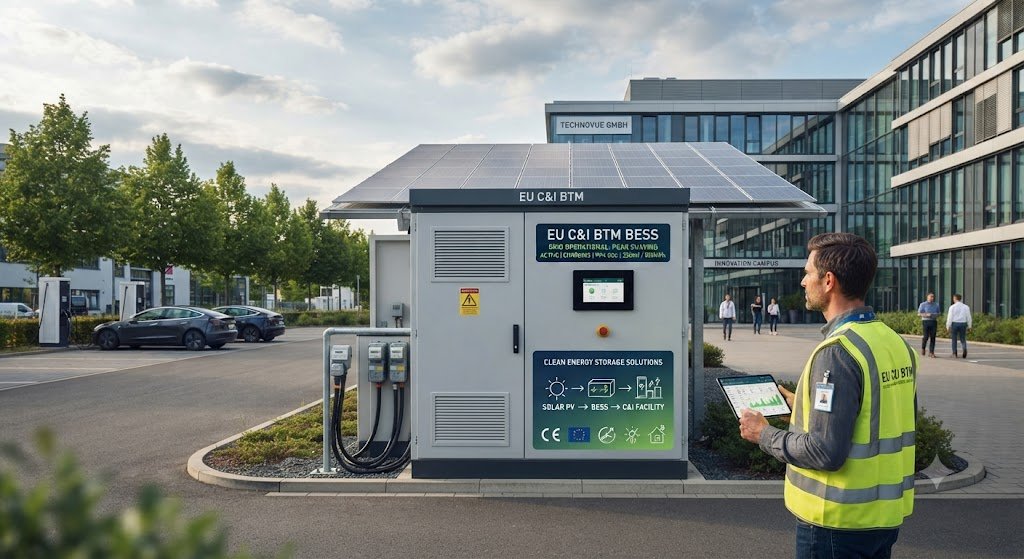
Europe C&I Behind-the-Meter BESS Market Analysis: Why Site Economics Matter
Europe's commercial and industrial energy landscape is changing as companies manage higher electrification, renewable generation, volatile power prices, and increasingly complex grid conditions. Behind-the-meter battery storage offers a way to make electricity consumption more flexible. Yet the business case is rarely determined by battery cost alone. Site load behavior, tariffs, network rules, operating schedules, and control capabilities can determine whether an installation creates meaningful value.
The Europe C&I Behind-the-Meter BESS Market is therefore becoming more sophisticated. Early purchasing decisions often focused on system capacity and expected payback. Newer projects increasingly consider the complete operating model. This includes how the battery will charge, when it will discharge, which loads can be shifted, how performance will be measured, and whether the asset can participate in external flexibility programs.
Energy cost management is one of the clearest use cases. Many facilities have concentrated consumption during particular periods. Storage can move electricity use away from expensive periods when the operational profile allows it. The effectiveness of this strategy depends on tariff design. A facility with predictable peaks may achieve stronger savings than a site with irregular demand, even when both install batteries of similar size.
The relationship between storage and onsite solar is also important. Commercial rooftops can generate substantial electricity during daytime hours, while some businesses consume more power later. A battery can capture a portion of surplus production and release it when demand rises. This can improve renewable utilization and reduce grid purchases. However, system sizing should reflect actual load profiles rather than simply maximizing battery capacity.
Operational resilience adds another dimension. Businesses such as warehouses, retail facilities, manufacturing sites, and temperature-controlled operations can face costs when power quality or continuity is disrupted. Batteries can support selected loads, provide rapid response, or coordinate with backup systems. These benefits can influence procurement decisions when operational continuity is strategically important.
Flexibility markets create further possibilities. Aggregators can combine multiple smaller systems and coordinate their response to market or network signals. Participation, however, depends on local rules, metering arrangements, dispatch permissions, and technical requirements. A battery that looks attractive under a theoretical flexibility model may generate less value if operational restrictions prevent dispatch during important periods.
This is why Europe C&I Behind-the-Meter BESS Market Analysis should focus on realized value rather than theoretical opportunity. Country differences can affect tariffs, network charges, flexibility access, and connection processes. Developers and investors need to examine these variables before applying assumptions across a regional portfolio.
Technology selection is evolving accordingly. Lithium-ion systems remain widely relevant, but the broader solution includes energy management software, power conversion equipment, monitoring systems, fire protection, communications, and controls. Software can become especially important because it determines how the asset responds to tariffs, solar production, operational priorities, and external signals.
For suppliers, the growing importance of digital management changes competitive requirements. Hardware remains essential, but software integration, analytics, service capabilities, and interoperability can influence customer decisions. For buyers, open interfaces and transparent data access may reduce dependence on a single technology provider.
Looking toward 2030, European C&I storage is likely to develop through multiple business models rather than one standardized pathway. Some sites will prioritize peak reduction, others solar self-consumption, resilience, flexibility revenues, or combinations of these applications. The strongest opportunities will be those where technical capability, site operations, and market rules align.
Ultimately, behind-the-meter storage should be treated as an energy management platform rather than a simple battery purchase. This approach can support scalable deployment while reducing the risk of relying on assumptions that do not match real operating conditions across portfolios.
