


How Grid Constraints Are Driving Europe’s Standalone BESS Market
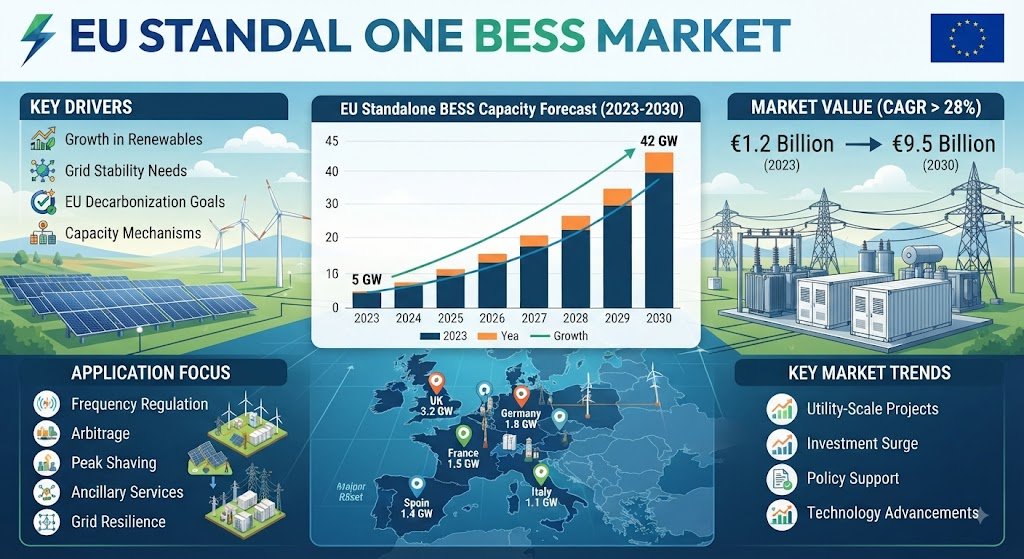
The European electricity system is becoming more flexible, but it is also becoming harder to balance. Renewable generation can rise or fall quickly, demand patterns are changing, and network congestion can prevent electricity from moving freely between regions. Standalone battery energy storage offers a practical response because it can absorb electricity during selected periods and release it when system conditions create greater value.
Batteries can provide fast frequency response, balancing support, intraday arbitrage, capacity services, congestion management, and resilience functions. Their ability to switch between applications gives standalone projects an advantage over assets designed around one fixed operating pattern. Yet that flexibility only creates value when the project can access the relevant markets and operate within the limits imposed by its connection.
This makes grid access a commercial issue, not merely a technical requirement. A developer may identify a site with strong theoretical price spreads, but network reinforcement, queue delays, import limits, export restrictions, or curtailment can reduce the usable value. The difference between nameplate capacity and dispatchable capacity can materially affect revenues, financing, and project valuation.
Investors are therefore paying greater attention to the quality of project pipelines. A large pipeline does not necessarily represent a large investable opportunity if many projects lack credible connection dates or face uncertain operating envelopes. Projects with clearer grid pathways can advance faster, secure capital earlier, and potentially achieve better commercial terms.
The EU Standalone BESS Market Report perspective highlights the importance of examining connection-to-cashflow rather than treating commissioning as a simple calendar milestone. This approach connects technical development with financial performance. Every month of delay can change revenue timing, debt coverage, working capital needs, and exposure to market conditions.
A battery may combine balancing products with intraday trading or congestion opportunities. However, stacking must be technically and contractually feasible. Availability requirements for one service may conflict with the battery's ability to capture another opportunity. Optimization platforms therefore need to prioritize services dynamically while maintaining state-of-charge requirements, degradation limits, and compliance obligations.
Market design is another source of uncertainty. European electricity reforms increasingly recognize flexibility and encourage mechanisms that can support investment. National regulators, transmission operators, distribution operators, balancing platforms, and market participants can apply different rules and timelines. Developers need country-specific diligence rather than assuming that one European policy framework creates identical commercial conditions.
Technology decisions should follow the operating strategy. Lithium iron phosphate systems are prominent for many projects because they offer a combination of performance, safety, and lifecycle characteristics. Longer-duration systems may become increasingly relevant where congestion, renewable oversupply, or capacity needs create longer shifting requirements. Emerging chemistries may also compete in selected applications where project economics reward different characteristics.
EPC delivery is becoming equally important. Grid-code compliance, protection systems, control integration, testing procedures, metering, and communications can create commissioning bottlenecks. Clear responsibility matrices between developer, EPC contractor, OEM, and network operator can reduce disputes and accelerate energization.
Operations then determine whether an installed battery performs as expected. Frequent cycling can increase maintenance requirements and degradation, while network constraints can change dispatch patterns. Operators need sophisticated forecasting, trading, and maintenance planning to preserve availability during the periods that generate the greatest commercial value.
For developers, the strongest approach is to combine site selection, grid diligence, commercial modeling, and route-to-market planning from the beginning. For investors, downside cases should test connection delays, reduced dispatch, merchant capture changes, and higher operating costs together rather than in isolation.
Standalone BESS is consequently evolving from a hardware-led opportunity into an integrated infrastructure business. The winners will be projects that connect reliably, operate intelligently, and monetize flexibility under real network conditions. As European storage deployment expands, the quality of execution and market access may matter more than headline capacity alone.
