


SOC Security Services for Indian Businesses: Critical Protection Without an In-House SOC
Why SOC Security Services Are Becoming Essential for Indian IT Teams
Indian IT businesses operate in environments where cloud platforms, remote access, business applications, endpoints, and third-party connections can create a broad security surface. Maintaining visibility across all of them is difficult when security teams are already responsible for daily IT operations. SOC security services provide a structured way to continuously monitor security events, investigate suspicious activity, and coordinate incident response without requiring every organization to build a dedicated Security Operations Center internally.
For IT businesses in India, the value is not simply having another cybersecurity tool. It is having an operational security capability that can identify meaningful threats, prioritize alerts, and support response when internal teams may be unavailable or overloaded.
What SOC Security Services Actually Provide
SOC security services combine continuous security monitoring, threat detection, alert analysis, and incident response into an operational security function. Instead of leaving security teams to interpret every event themselves, a SOC helps distinguish routine activity from events that require investigation or action.
For an IT organization, this means security information can be monitored across relevant infrastructure while analysts investigate suspicious behavior and escalate incidents according to defined response processes.
The distinction matters because collecting security data is not the same as operating security effectively. A dashboard can show thousands of events; a functioning SOC must determine which events deserve attention.
Why a Managed SOC Service Provider Can Change the Operating Model
The decision to work with a managed soc service provider is often driven by operational reality rather than a desire to outsource everything. IT companies may have capable infrastructure professionals but lack the specialist resources required for continuous security monitoring, threat investigation, and incident handling.
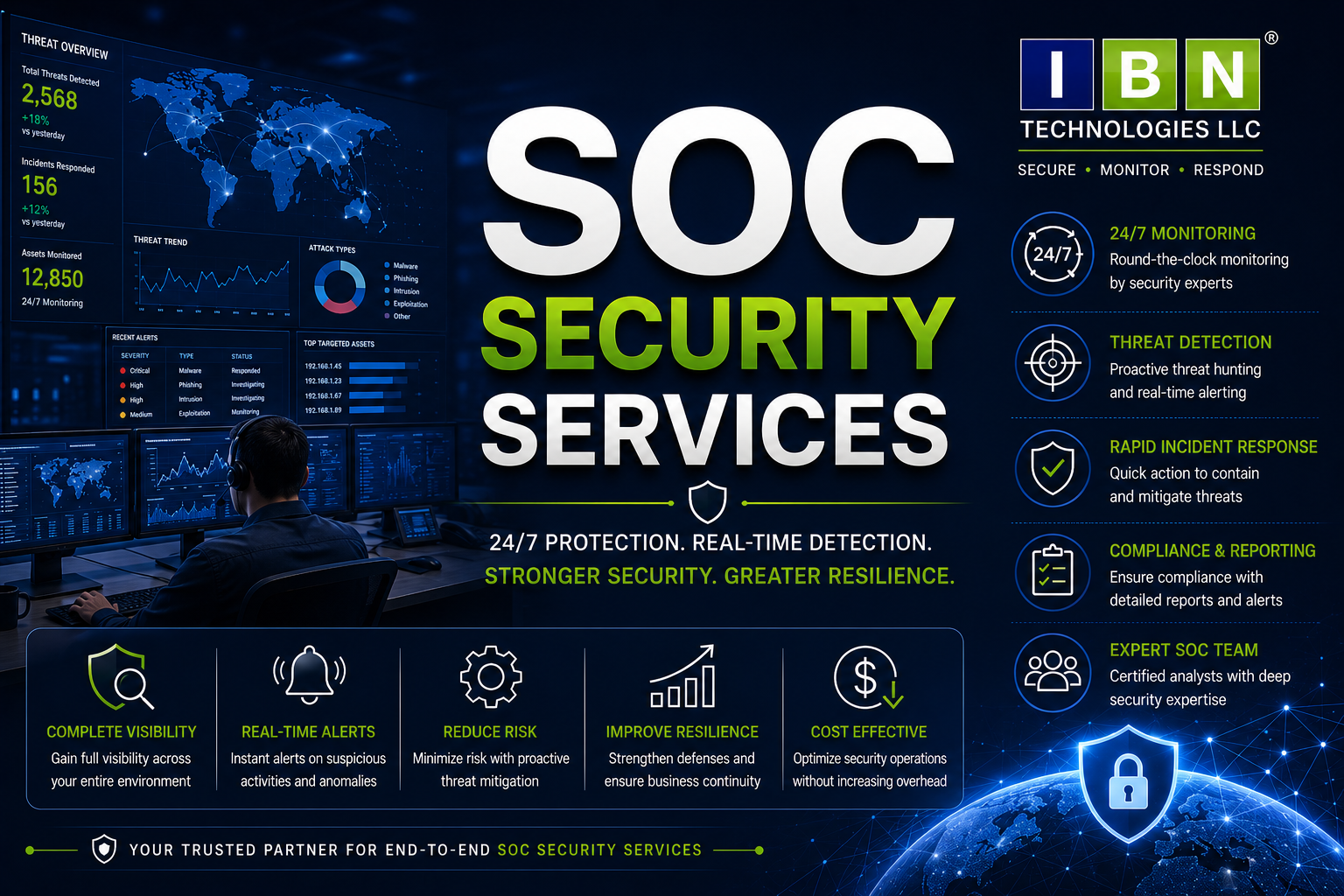
A managed model can provide access to dedicated security expertise while allowing the internal IT team to remain focused on applications, infrastructure, users, and business priorities. IBN Technologies describes its managed SOC offering as providing 24/7 monitoring, threat detection, incident response, security-device monitoring, and compliance-oriented reporting.
This approach can be particularly useful when security requirements extend beyond normal business hours or when an organization wants broader monitoring without creating a full internal SOC function.
Where SOC Security Services Fit Into IT Security
SOC security services sit between security technology and day-to-day security operations. They can bring together information from security devices, endpoints, cloud environments, networks, and other relevant systems so suspicious activity can be investigated in context.
The goal is not to generate more alerts. It is to improve the organization's ability to recognize meaningful events and respond appropriately.
Why DIY Monitoring Often Becomes Difficult
An IT company can deploy firewalls, endpoint protection, cloud security controls, and logging platforms without necessarily having an effective monitoring operation.
The first challenge is alert volume. Security technologies can produce events continuously, and not every event represents an active threat. Without suitable analysis and tuning, teams can spend valuable time investigating low-priority activity.
The second challenge is coverage. Security incidents do not follow office hours. A team that monitors manually during business hours may have limited visibility when fewer people are available.
The third challenge is expertise. Incident investigation may require knowledge of attack behavior, log analysis, endpoint activity, cloud environments, and response procedures. These skills are not always available within a general-purpose IT team.
Building an internal SOC can address some of these challenges, but it also introduces responsibilities around staffing, technology, processes, continuous training, and operational management.
What to Evaluate Before Choosing a SOC Service
A provider should be assessed on how its security operation actually works, not simply on the number of tools it mentions.
Look for:
-
Continuous monitoring: Understand whether monitoring is genuinely available around the clock.
-
Human analysis: Determine how security professionals participate in alert validation and investigation.
-
Incident response: Confirm that the service extends beyond alert forwarding into investigation and response support.
-
Technology integration: Check whether the SOC can work with the organization's existing security environment.
-
Threat intelligence: Assess how external threat information contributes to detection and investigation.
-
Reporting: Look for operational and compliance-oriented reporting that security and management teams can understand.
-
Scalability: Make sure the service can accommodate changes in infrastructure, workloads, and business requirements.
-
Response processes: Clarify escalation procedures and how serious incidents are handled.
IBN Technologies states that its managed SOC and SIEM services include threat hunting, security-device monitoring, incident response and forensics, compliance-driven monitoring, and 24/7 global SOC monitoring.
What an IT Use Case Can Look Like
Consider an Indian IT services organization supporting multiple client environments. Its infrastructure may include cloud workloads, employee endpoints, network devices, and business applications.
An unusual authentication event occurs outside the employee's normal pattern. On its own, the event may not prove compromise. A SOC can investigate related activity, examine available security telemetry, assess whether other suspicious indicators are present, and determine whether escalation is warranted.
The business benefit comes from turning isolated security events into an investigated security narrative.
This also helps internal IT personnel avoid treating every unusual event as an emergency. Instead, they can receive prioritized incidents supported by relevant context and follow an established response process.
Benefits Beyond Threat Detection
Effective SOC operations can influence more than the immediate identification of cyber threats.
For IT businesses, stronger monitoring can improve visibility across distributed environments. Consistent investigation processes can make incident handling more repeatable. Security reporting can also give management clearer insight into recurring risks and operational priorities.
Another benefit is scalability. As infrastructure expands, maintaining security visibility through an entirely manual approach can become increasingly difficult. A managed SOC can provide an operational layer that grows alongside the environment rather than requiring the organization to recreate its security team every time its technology footprint changes.
The model can also help internal IT teams concentrate on strategic initiatives instead of continuously reviewing security alerts.
Compliance Should Be Part of the Conversation
Security monitoring and compliance are closely connected, but compliance should not be treated as a substitute for security.
For organizations operating in India, the appropriate regulatory and contractual requirements depend on their activities, customers, data, and operating environment. A SOC can support this broader governance effort through monitoring and audit-oriented reporting.
IBN Technologies states that its SOC and SIEM services support compliance-oriented reporting associated with frameworks and requirements including ISO 27001, PCI-DSS, GDPR, HIPAA, RBI, and SEBI, depending on the applicable environment.
Organizations should still establish their own compliance obligations and confirm exactly which controls and reporting capabilities are relevant before selecting a service.
Practical Questions for IT Leaders
Before moving forward, IT and security leaders should be able to answer a few basic questions:
-
Which systems and environments need continuous monitoring?
-
Which security events currently receive the most internal attention?
-
How are critical incidents escalated today?
-
What happens when an alert occurs outside normal working hours?
-
Which security technologies need to integrate with the SOC?
-
How much investigation can the internal team realistically handle?
-
What security reports does management need?
-
Which compliance requirements affect the organization?
-
What level of response should remain with the internal team?
-
How will the SOC's performance be reviewed over time?
These questions help shift the buying decision away from features alone and toward operational fit.
Building a More Resilient Security Operation
Cybersecurity for an IT business is not achieved by purchasing one more security platform. It depends on visibility, skilled analysis, clear escalation, and the ability to act when something genuinely requires attention.
For Indian IT organizations that do not want to build and maintain every component of an internal SOC, outsourcing can provide another operating model. The right provider should complement existing technology and people rather than simply add another stream of alerts.
SOC security services can therefore become part of a broader security strategy: continuous monitoring for visibility, expert investigation for context, and structured response for resilience. For businesses balancing growth with increasingly complex security responsibilities, that operational capability can be a practical way to strengthen protection without making security management another full-time infrastructure project.
Contact Us:
IND- 02067680404
