


Climate Adaptation Market Growth Gains Strength From Public-Private Investment
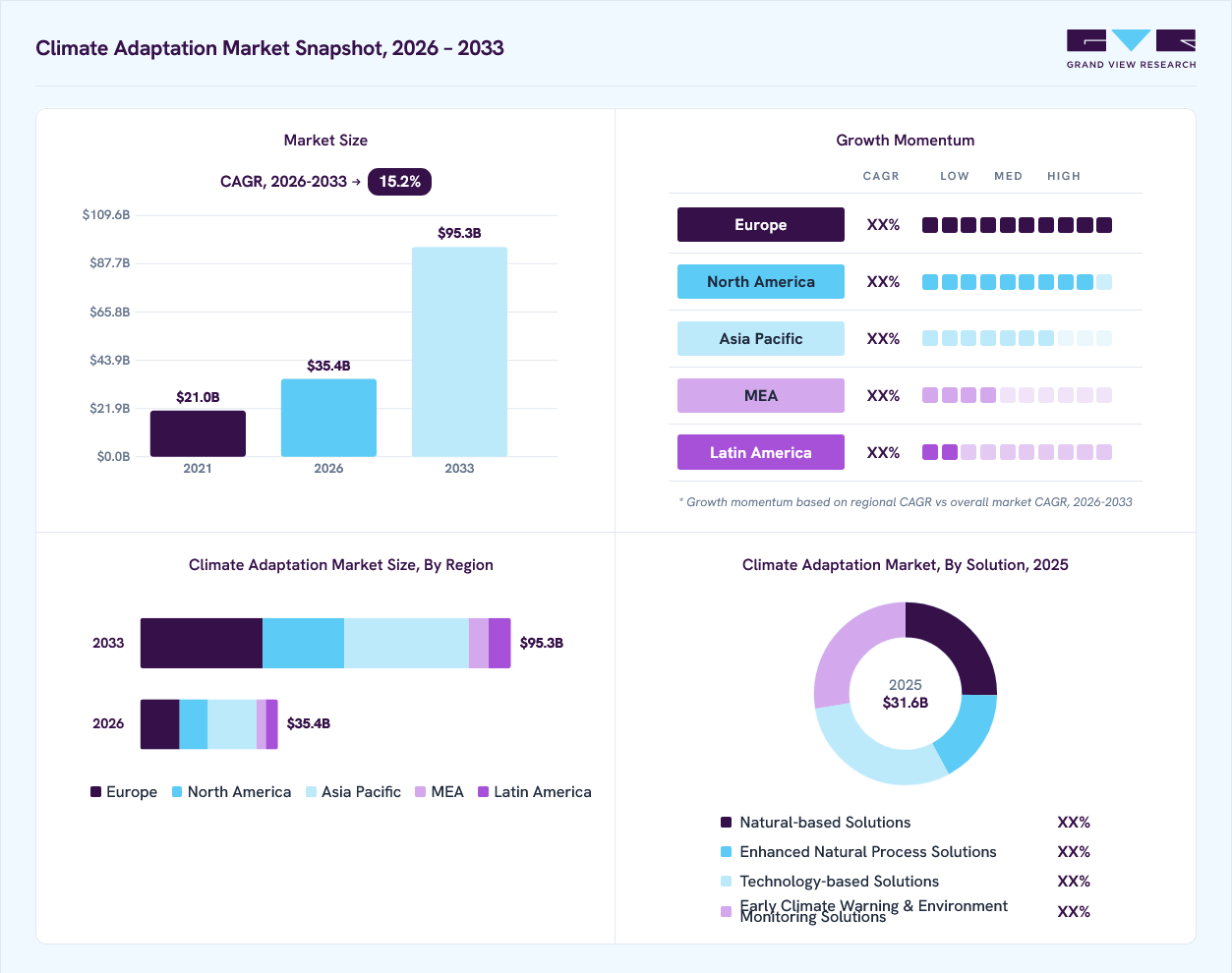
The climate adaptation market is expanding rapidly as governments, businesses, and infrastructure operators respond to increasingly frequent extreme weather events, climate-induced disruptions, water stress, and environmental risks. The market was valued at USD 31.6 billion in 2025 and is projected to grow from USD 35.4 billion in 2026 to USD 95.3 billion by 2033, representing a CAGR of 15.2% from 2026 to 2033. Asia Pacific accounted for the largest market share of 35.4% in 2025, reflecting substantial exposure to climate hazards and increasing investment in resilience.
Market Size & Regional Breakdown
The market's expansion is supported by the growing frequency of extreme weather events and the need to protect infrastructure, communities, natural resources, and economic activities. Asia Pacific dominated the market with a 35.4% revenue share in 2025. High exposure to typhoons, floods, droughts, rising temperatures, and other climate hazards is encouraging governments and organizations to strengthen adaptation planning and disaster risk management.
North America also represented a significant revenue share in 2025, supported by increasing attention to climate-resilient infrastructure, environmental monitoring, coastal protection, urban planning, and disaster preparedness. Europe is similarly advancing adaptation strategies through policy frameworks, regional cooperation, water management, ecosystem protection, and resilient infrastructure planning.
China held the largest share by country in 2025. The regional market is being supported by development banks, international organizations, government programs, and investments aimed at improving infrastructure resilience and climate-risk management.
Core Technology & Investment Sectors
Technology-based solutions represented the largest solution segment, accounting for 30.2% of market revenue in 2025. Increasing demand for advanced digital and engineering technologies is encouraging organizations to use artificial intelligence, satellite-based earth observation, and climate data analytics for climate modeling, risk assessment, and adaptation planning.
The government industry represented the largest industry segment with a 23.7% revenue share in 2025. Public authorities are allocating resources toward climate-resilient infrastructure, disaster risk reduction programs, environmental monitoring, and adaptation strategies designed to address changing temperatures, precipitation patterns, and extreme weather.
· Early Warning & Atmospheric Intelligence
Primary Trends: The increasing frequency and intensity of floods, cyclones, droughts, heatwaves, and other extreme events are creating stronger demand for timely climate information. Early warning systems can provide alerts that allow governments, communities, and organizations to take preventive measures before hazards cause extensive damage. Environmental monitoring networks are also supporting continuous tracking of climate variables and improving forecasting and disaster response planning.
Key Innovations: Satellite-based climate monitoring is becoming increasingly important because it enables continuous observation of atmospheric conditions, ocean dynamics, land surface changes, and environmental degradation. Greater availability of high-resolution satellite imagery and climate data is helping improve forecasting models and strengthen climate-risk assessment. AI-driven analytics and geospatial data systems are also transforming large volumes of climate information into actionable insights.
· Resilient Infrastructure & Grid Hardening
Primary Trends: Climate variability is increasing pressure on infrastructure systems, including power generation, transportation, water networks, and coastal assets. Power generation is predicted to experience significant growth as electricity infrastructure faces rising temperatures, floods, storms, droughts, and wildfires. These hazards can cause operational disruptions, infrastructure damage, and interruptions across fuel supply chains.
Key Innovations: Resilient infrastructure investment includes climate-adaptive designs, environmental monitoring, improved water systems, and technologies capable of supporting infrastructure planning under changing climate conditions. Water resilience is particularly important as changing precipitation patterns and prolonged droughts increase pressure on existing supply systems. Advanced water storage systems, climate-resilient reservoirs, and improved distribution networks are gaining momentum.
· Climate-Smart Agriculture & Water Security
Primary Trends: Water scarcity and changing precipitation patterns are making reliable resource management increasingly important. Governments and utilities are investing in adaptive water infrastructure to maintain availability during climate disruptions. Climate adaptation technologies are also supporting agriculture and other resource-dependent activities by improving resilience against climate variability and environmental stress.
Key Innovations: Climate data analytics, satellite earth observation, environmental monitoring, and advanced water-management technologies are helping organizations better understand changing environmental conditions. These tools can support planning around water availability, agricultural resilience, infrastructure requirements, and disaster preparedness.
Emerging Financing Structures
Public-private partnerships and climate finance initiatives are strengthening the development and deployment of large-scale adaptation solutions. Governments, enterprises, development banks, and international organizations are increasingly involved in funding resilience projects and capacity-building programs. This collaborative investment environment is helping expand access to adaptation technologies and accelerate infrastructure development.
The market ecosystem is also evolving through technology partnerships and new climate intelligence platforms. Recent developments include the launch of DTN Weather Hub in January 2026, designed to provide real-time weather intelligence for operational decision-making. In February 2025, IBM collaborated with the C40 Cities on AI-driven solutions for urban climate resilience.
Key Climate Adaptation Companies:
· BARANI DESIGN Technologies s. r. o.
· Campbell Scientific, Inc.
· Carbon Engineering ULC
· Climeworks
About us:
Grand View Research, a market research and consulting company, provides syndicated research reports, customized research reports, and consulting services. Grand View Research database is used by the world's renowned academic institutions and Fortune 500 companies to understand the global and regional business environment. Our database features thousands of statistics and in-depth analysis on 46 industries in 25 major countries worldwide.
