


Europe Waste-to-Energy Projects: Investment Factors and Emerging Opportunities
Why Waste-to-Energy Capacity Matters for Europe’s Energy Transition
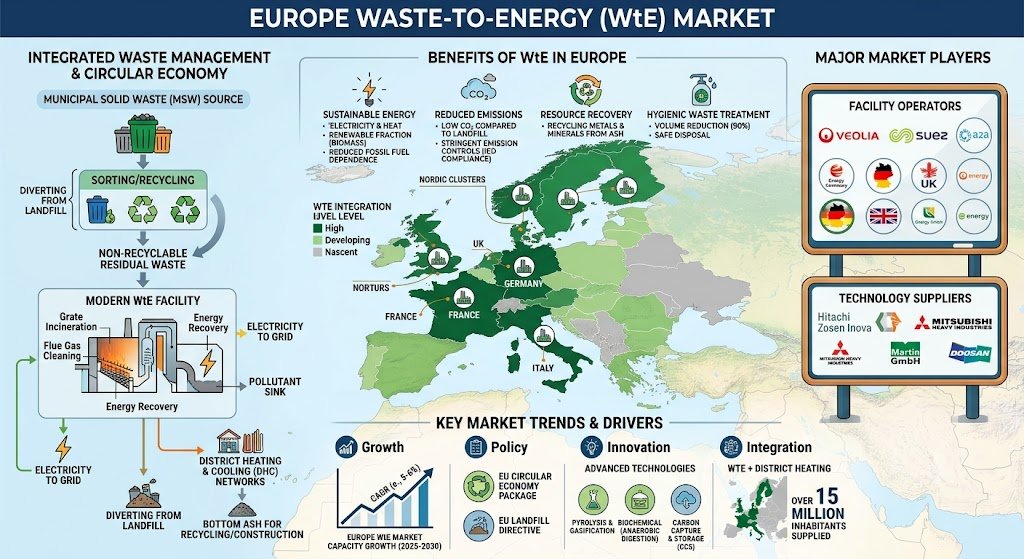
Europe is rethinking how cities manage residual waste as landfill pressure, energy security, and climate objectives increasingly converge. Waste-to-energy facilities can convert non-recyclable waste into useful electricity, heat, or both, creating infrastructure that serves environmental and energy priorities at the same time. This changing role is making the sector increasingly important across European markets.
Modern waste-to-energy is not simply an incineration story. It is part of a broader resource management system that begins with prevention, reuse, recycling, and recovery. The material that remains after higher-value options have been exhausted can provide a dependable feedstock for energy recovery. For municipalities, this can reduce landfill dependence while supporting predictable local energy supply.
One important driver is urbanization. European cities generate substantial volumes of municipal solid waste every day, and dense populations require reliable collection, treatment, and disposal systems. Facilities located close to demand centers can also supply district heating networks, making combined heat and power particularly valuable in colder regions. The ability to produce heat as well as electricity can improve overall energy efficiency and strengthen the economics of suitable projects.
Policy is another major influence. European environmental strategies increasingly emphasize resource efficiency, emissions reduction, landfill diversion, and circular-economy principles. These priorities encourage authorities to evaluate waste treatment as an integrated system rather than as a standalone disposal activity. At the same time, strict emissions standards require operators to invest in advanced combustion controls, flue-gas treatment, monitoring, and residue management.
Technology choices are evolving as well. Conventional mass-burn plants remain important, but developers and operators are exploring improved energy recovery, digital process controls, automation, heat integration, carbon management, and more efficient pollution-control systems. Artificial intelligence and advanced analytics can help optimize plant performance by identifying operating patterns, improving maintenance planning, and supporting more consistent output.
Investment decisions increasingly depend on local waste composition, energy prices, district heating demand, grid access, permitting conditions, and long-term feedstock arrangements. A facility can perform very differently depending on whether it primarily sells electricity, supplies heat, receives treatment fees, or combines several revenue streams. This makes project evaluation highly location-specific.
Another consideration is public acceptance. Communities expect waste facilities to operate safely, transparently, and with strong environmental controls. Clear communication about emissions, monitoring results, traffic, noise, and resource recovery can help build confidence. Projects that integrate with local heating or industrial systems may also demonstrate tangible benefits beyond waste treatment.
The sector can contribute to decarbonization, but its climate value depends on feedstock and operating practices. Maximizing recycling remains essential, while energy recovery should focus on residual materials that cannot reasonably be recycled. Operators can further improve environmental performance through energy efficiency, renewable electricity integration, low-carbon heat use, and exploration of carbon capture where technically and economically appropriate.
For investors and industry participants, the market therefore combines infrastructure characteristics with changing policy and energy dynamics. Understanding capacity pipelines, technology upgrades, waste availability, revenue structures, and regional demand is essential for identifying durable opportunities.
Overall, European waste-to-energy is becoming a more integrated component of urban infrastructure. Its future will depend on balancing resource recovery, emissions performance, energy value, affordability, and public expectations. As Europe advances toward more circular and resilient systems, efficient treatment of residual waste can remain an important bridge between environmental management and dependable energy services. Evaluating Europe Waste-to-Energy Market Size also means recognizing regional variation. Countries differ in landfill policies, waste composition, heating demand, energy prices, financing conditions, and public acceptance. These differences create distinct project economics and technology requirements. A flexible approach reflecting local conditions can improve investment decisions and support facilities capable of delivering dependable treatment services alongside valuable energy outputs over long periods with consistency.
