


Why Lifecycle Management Is Becoming Critical for Europe’s Nuclear Power Assets
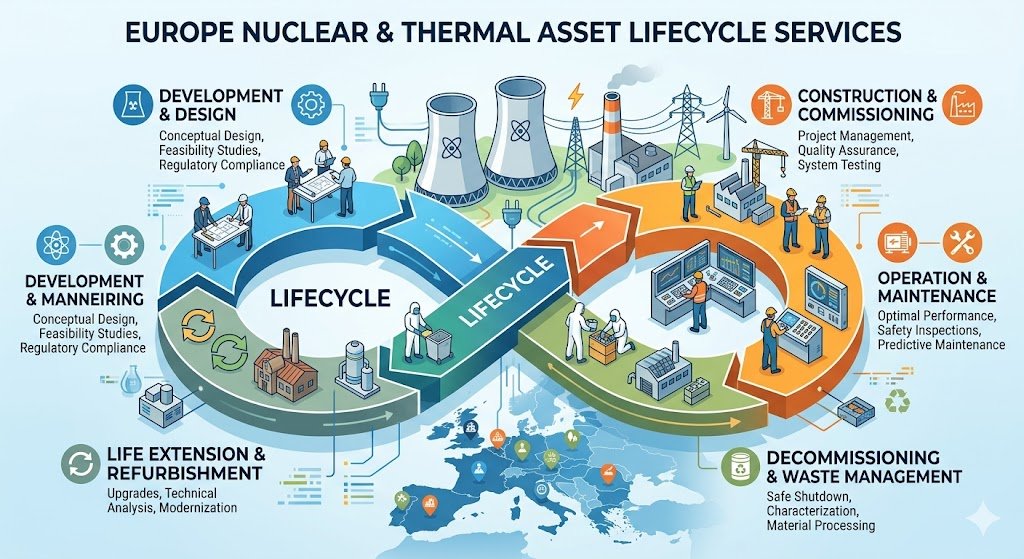
Nuclear Life Extension and Thermal Modernization Create New European Opportunities
Europe's energy transition is placing greater attention on the performance of existing power generation assets. Renewable capacity is expanding rapidly, but nuclear and thermal facilities continue to contribute electricity, flexibility, industrial heat, and system stability in several countries. As a result, asset owners are increasingly examining whether existing plants should be maintained, modernized, extended, or retired. Each decision creates a distinct requirement for specialized lifecycle services.
Nuclear life extension is one of the strongest areas of opportunity. Extending reactor operation requires comprehensive technical evaluation and evidence demonstrating that systems, structures, and components can continue performing safely. Engineering companies and contractors may support aging management, inspection, testing, safety analysis, equipment replacement, digital upgrades, and regulatory documentation.
The Europe Nuclear & Thermal Asset Lifecycle Services Market Report emphasizes that the opportunity is increasingly linked to execution quality. A technically sound project can still encounter delays if inspection findings are discovered late, qualified components are unavailable, or documentation requires rework. This makes schedule management and quality assurance essential elements of lifecycle service delivery.
Thermal modernization follows a different pathway. Some facilities are being prepared for longer operating periods because they remain useful for balancing renewable generation. Others are being modified to improve efficiency, operational flexibility, emissions performance, or integration with industrial heat networks. Service opportunities can include turbine upgrades, generator maintenance, boiler work, controls modernization, inspection, efficiency improvements, and predictive maintenance.
The changing role of gas-fired generation is particularly relevant. Gas plants may operate differently in systems with increasing renewable penetration. Rather than running continuously, some units may cycle more frequently to respond to demand and renewable output. More flexible operation can increase mechanical and thermal stress, making maintenance strategies more important.
Combined heat and power facilities face similar considerations. Their economic value may depend not only on electricity generation but also on reliable heat delivery. A failure can therefore affect industrial operations or district heating customers. Lifecycle programs must account for both generation availability and heat-system requirements.
Nuclear and thermal service providers are also adapting to higher documentation expectations. Regulators, insurers, lenders, and asset owners increasingly require evidence that maintenance activities were completed correctly and that engineering decisions can be traced to reliable information. Digital records, inspection databases, configuration management systems, and standardized work packages can help establish this traceability.
Another major opportunity lies in specialist inspection and testing. Non-destructive examination, vibration monitoring, thermal imaging, corrosion assessment, materials testing, and electrical diagnostics can identify deterioration before it becomes a major failure. Early detection may allow operators to schedule repairs during planned outages rather than responding to unexpected events.
Contracting strategies are also changing. Long-term framework agreements can provide continuity for recurring maintenance, while performance-based contracts may align service provider incentives with availability or reliability objectives. Project-based contracts remain important for major upgrades and decommissioning work.
Decommissioning will increasingly influence the market as European coal closures continue and some nuclear facilities approach permanent shutdown. Planning early can help owners understand dismantling requirements, environmental obligations, waste roads, site restoration, and stakeholder concerns. Contractors with experience in both operational support and closure activities may have an advantage because they can maintain asset knowledge through transition.
Overall, the European lifecycle services market is becoming more strategic. It is no longer limited to keeping machinery operational. It involves decisions about reliability, regulatory acceptance, flexibility, capital efficiency, and eventual closure. Service companies that combine technical expertise, digital capabilities, project governance, and lifecycle knowledge can capture opportunities created by Europe's increasingly complex generation portfolio.
